Vilnius: Capital of Lithuania
A baroque jewel where an iron wolf dream built an empire — and where a quirky artist district declared itself an independent republic on April Fools' Day.
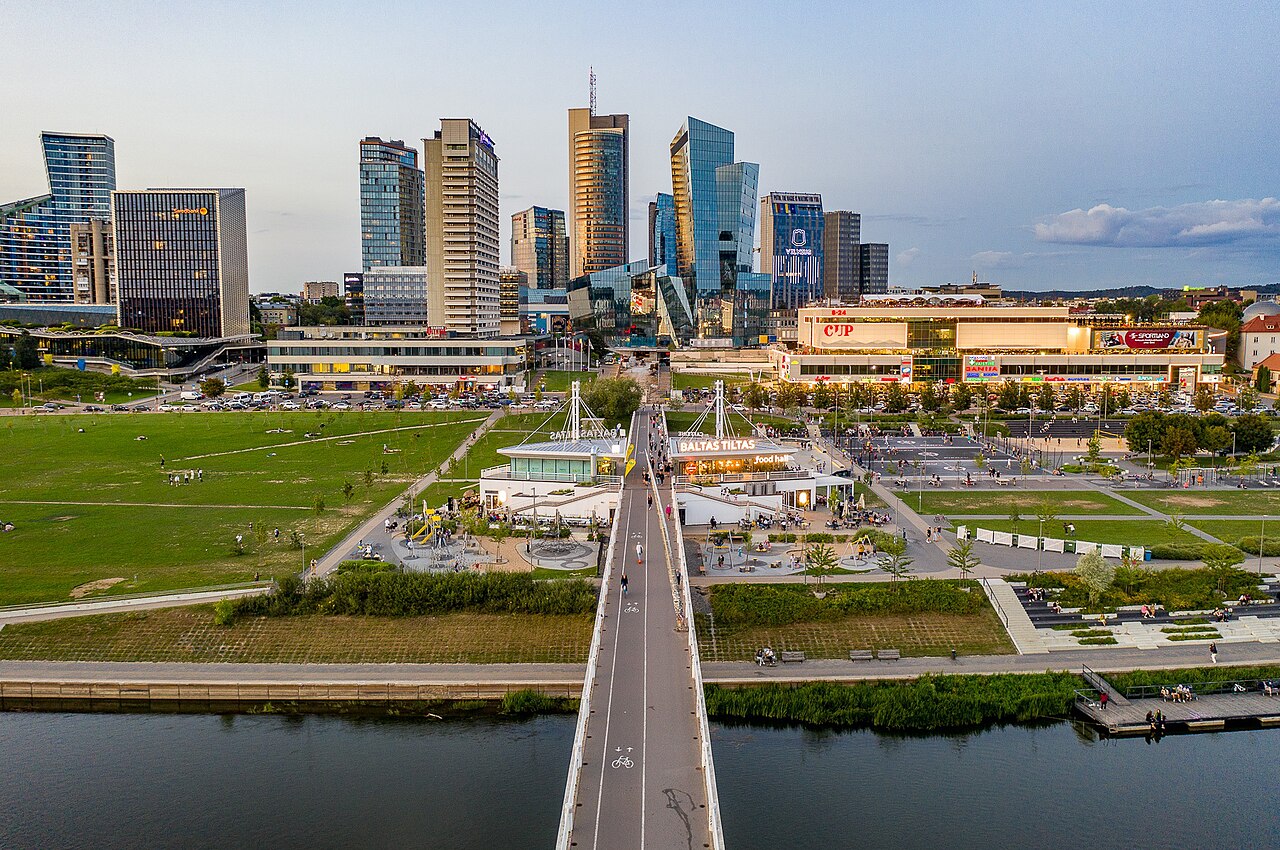
Vilnius old town from Gediminas Tower
Public domain (Wikimedia Commons)
| Founded | c. 1323 by Grand Duke Gediminas |
| Population | ~540,000 |
| UNESCO | Old Town (1994) |
| Language | Lithuanian (most archaic Baltic language) |
| Independence | March 11, 1990 (first Soviet republic) |
History
The Iron Wolf Dream
According to legend, Grand Duke Gediminas camped at the confluence of the Vilnia and Neris rivers and dreamed of an iron wolf howling with the voice of a hundred wolves. His high priest interpreted this as a sign to build a mighty city there. Gediminas founded Vilnius around 1323 and made it the capital of the Grand Duchy of Lithuania — one of the largest states in medieval Europe, stretching from the Baltic Sea to the Black Sea at its peak.
Jerusalem of Lithuania
The Grand Duchy of Lithuania was one of the most religiously tolerant states of medieval Europe. The city's Jewish community grew into one of the most important centres of Jewish learning in the world — Napoleon reportedly called Vilnius the "Jerusalem of Lithuania" when he passed through in 1812. The Holocaust nearly erased this 600-year-old community; of approximately 100,000 Jews in the Vilnius region before WWII, roughly 95% were murdered.
First to Leave the USSR
On March 11, 1990, Lithuania declared the restoration of its independence — the first Soviet republic to do so. Soviet tanks rolled in; troops killed 14 civilians defending the Vilnius TV Tower in January 1991. Lithuania held firm, and the act of defiance inspired the Baltic Way and accelerated the collapse of the Soviet Union. Lithuania joined the EU and NATO in 2004.
Landmarks & Culture
UNESCO Baroque Old Town
Vilnius has the largest surviving medieval old town in Northern Europe — a UNESCO World Heritage Site since 1994. Over 1,500 buildings of architectural interest are compressed into 3.6 km², dominated by baroque churches and courtyards layered over Gothic foundations.
Užupis — The Republic Within the City
On April 1, 1993, the bohemian Užupis district declared itself an independent republic — with its own constitution (41 articles), president, anthem, and army of 12 volunteers. The constitution includes: "Everyone has the right to be a cat" and "Everyone has the right to make mistakes." A Frank Zappa statue watches over the district — a symbol of anti-Soviet counterculture. The whole thing is completely earnest.
Fast Facts
- The Grand Duchy of Lithuania at its 15th-century peak covered an area larger than modern France.
- Lithuanian is one of the most archaic living Indo-European languages, preserving features lost in most others.
- Vilnius's old town has over 65 churches — extraordinary density for a city of 540,000.
- Lithuania was the last country in Europe to be officially Christianized — in 1387 AD.
- At the Battle of Grunwald (1410), Lithuanian and Polish forces defeated the Teutonic Knights in one of the largest medieval battles in history.
📊 Lithuania in Numbers
- Grand Duchy at peak: ~930,000 km² (larger than France)
- Užupis constitution articles: 41
- Old town buildings of historic value: 1,500+
- Date of independence from USSR: March 11, 1990 (first Soviet republic)