Vienna: Capital of Austria
For 600 years the seat of the Habsburg Empire. Mozart, Beethoven, Freud, Klimt — and a city that twice withstood Ottoman siege. The most liveable city in the world.
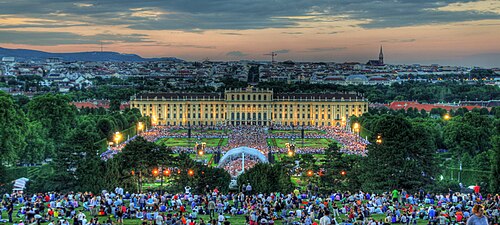
Schönbrunn Palace gardens
Public domain (Wikimedia Commons)

| Population | 1.9 million (city) |
| Founded | c. 500 BC; Roman Vindobona from 15 BC |
| Language | German (Austrian variety) |
| Habsburg rule | 1282–1918 |
| Ottoman sieges | 1529 and 1683 — both repelled |
| Global rank | Most liveable city (Economist Intelligence Unit) |
History
Roman Vindobona to Habsburg Capital
The site of Vienna has been inhabited since the Stone Age. The Celts built a settlement here; the Romans established the legionary fortress Vindobona in 15 BC as a Danube frontier outpost. The Habsburg dynasty took control of Austria in 1282 and made Vienna their capital — a seat of power they would hold for over 600 years, ruling the Holy Roman Empire from 1438 to 1806 and then the Austrian Empire and Austro-Hungarian Empire until 1918.
The Ottoman Sieges
Vienna stood as the eastern frontier of Christian Europe against the Ottoman Empire. In 1529, Suleiman the Magnificent's army besieged the city but withdrew. In 1683, an Ottoman army of 150,000 surrounded Vienna. The city was on the verge of starvation when a relief army led by King Jan III Sobieski of Poland and Imperial forces broke the siege at the Battle of Vienna on September 12 — one of the decisive battles in European history. The subsequent defeat of Ottoman expansion in Central Europe permanently shifted the power balance.
The City of Music
No city has been more central to the history of Western classical music. Mozart composed most of his greatest works in Vienna; Haydn worked here; Beethoven moved to Vienna at 21 and never left; Schubert was born here; Brahms, Bruckner, Mahler, and Richard Strauss all worked here. The Vienna Philharmonic, founded in 1842, and the Vienna State Opera, built in 1869, remain among the world's most prestigious musical institutions. Vienna's New Year's Concert — broadcast globally — draws 50 million viewers.
Vienna 1900: The Intellectual Explosion
At the turn of the 20th century, Vienna was one of the most intellectually fertile places on earth. Sigmund Freud developed psychoanalysis here. Gustav Klimt and Egon Schiele founded the Vienna Secession, breaking with academic art. Ludwig Wittgenstein revolutionised philosophy. Arnold Schoenberg dismantled tonality. And a young failed artist named Adolf Hitler spent his formative years here, rejected by the Academy of Fine Arts, nursing resentments that would reshape the world.
Landmarks
Schönbrunn Palace
Schönbrunn — the Habsburgs' main summer residence — contains 1,441 rooms and is surrounded by 160 hectares of formal gardens. The young Mozart performed here for Empress Maria Theresa at age 6; Napoleon used it as his headquarters in 1805 and 1809; the young Emperor Franz Joseph was born here. Its gardens contain the world's oldest zoo still operating at its original site (founded 1752).
The Ringstrasse
Emperor Franz Joseph I ordered the demolition of Vienna's medieval city walls in 1857, replacing them with the grand Ringstrasse boulevard — a showcase of 19th-century Habsburg power. Along its 5.3 km stand the Vienna State Opera, the Kunsthistorisches Museum, the Naturhistorisches Museum, the Parliament, the City Hall, the Burgtheater, and the University — each in a different historical style (Neo-Gothic, Neo-Classical, Neo-Baroque).
Fast Facts
- Vienna has been ranked the world's most liveable city for over a decade by the Economist Intelligence Unit
- The city has 27 Michelin-starred restaurants and is famous for its Kaffeehauskultur (coffeehouse culture) — a UNESCO Intangible Heritage
- The Lipizzaner horses of the Spanish Riding School have been trained in Vienna since 1572
- Vienna's sewage system inspired The Third Man (1949) — Carol Reed's film noir set in postwar Vienna
- The Wiener Schnitzel (breaded veal cutlet) is Vienna's most iconic dish — though its origins may trace to Milan