Athens: Capital of Greece
Democracy, philosophy, the Parthenon. Athens gave the Western world its intellectual foundations. The birthplace of Socrates, Plato, and the Olympic Games.
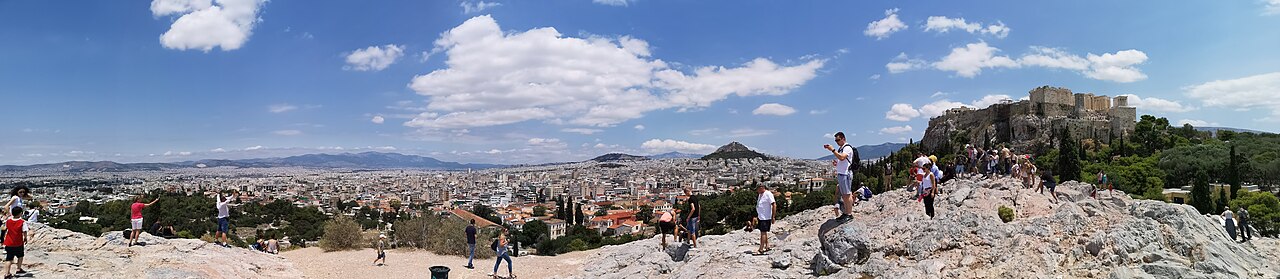
The Acropolis of Athens
Public domain (Wikimedia Commons)
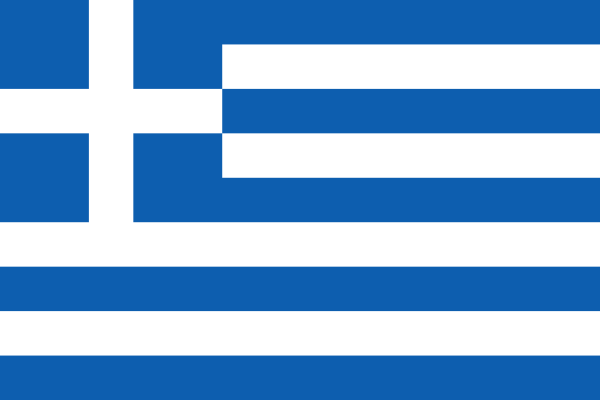
| Population | 665,000 (city); 3.7 million (metro) |
| Inhabited | Over 3,400 years continuously |
| Language | Greek |
| Acropolis | Parthenon completed 432 BC |
| Modern Olympics | First held here in 1896 |
| Ottoman rule | 1458–1833 |
History
The Golden Age of Pericles
Athens has been continuously inhabited since at least 1400 BC, with traces of human activity dating back 7,000 years. Its extraordinary rise came in the 5th century BC — the Golden Age under the statesman Pericles (c. 495–429 BC). In this single century, Athens produced: democracy (developed by Cleisthenes, refined by Pericles); philosophy (Socrates, then his student Plato, then Plato's student Aristotle); tragedy and comedy (Aeschylus, Sophocles, Euripides, Aristophanes); history (Herodotus, Thucydides); and the Parthenon — all in the span of one human lifetime. No city has had a more concentrated cultural impact on human civilisation.
Macedonian Conquest and Roman Rule
Athens' political dominance ended with defeat in the Peloponnesian War against Sparta (431–404 BC). Its cultural influence, however, was only amplified. Alexander the Great — Aristotle's student — spread Greek language and culture across the known world. Under Roman rule from 146 BC, Athens was treated as a sacred cultural centre; emperors restored and embellished its monuments. The city remained a centre of learning until the Emperor Justinian closed its philosophical schools in 529 AD.
Ottoman Period and Greek Independence
Athens fell to the Ottoman Empire in 1458 — the Parthenon was converted into a mosque. For nearly four centuries the city was a provincial backwater of about 10,000 people. The Greek War of Independence (1821–1829), partly inspired by Enlightenment ideals, was supported by European Philhellenes — most famously Lord Byron, who died at Missolonghi in 1824. After independence, Athens was chosen as the capital of the new Greek state in 1833. The first modern Olympic Games were held here in 1896, reviving an ancient tradition dormant for 1,500 years.
Landmarks
The Acropolis and Parthenon
The Acropolis (literally "high city") is a flat-topped rock rising 156 metres above Athens, crowned by the Parthenon — a temple to the goddess Athena, completed in 432 BC. Architecturally it is a masterpiece of optical illusion: its columns slightly lean inward, its stylobate (base) curves upward in the centre, all to counteract the human eye's tendency to see straight lines as sagging. The Elgin Marbles — frieze sculptures removed by Lord Elgin in 1801–12 — are held by the British Museum despite ongoing Greek requests for their return; the Acropolis Museum (2009) was designed specifically to house them if they come home.
The Ancient Agora
The Agora was the civic, commercial, and social heart of ancient Athens — where citizens voted, argued philosophy, bought olive oil, and watched theatre. Socrates famously conducted his dialogues here. The Stoa of Attalos, a 2nd-century BC colonnade, has been reconstructed and serves as a museum. The well-preserved Temple of Hephaestus (c. 450 BC) at the Agora's edge is one of the best-preserved ancient Greek temples in existence.
Fast Facts
- Athens gave Western civilisation the concept of democracy — though Athenian democracy excluded women, slaves, and foreigners
- The Marathon running event takes its name and distance (42.195 km) from the legend of Pheidippides running from the Battle of Marathon to Athens in 490 BC
- Athens hosted the 2004 Olympic Games — returning the modern Olympics to their birthplace for the first time since 1896
- The Acropolis Museum (2009), designed by Bernard Tschumi, is one of Europe's most admired modern museums
- Greek is one of the world's oldest recorded living languages — Linear B tablets from 1400 BC are recognisably Greek
📜 Notable Quote
"I would rather be the second man in Rome than the first in Athens."
Julius Caesar — measuring himself against the greatest city of the ancient world.
How well do you know the cradle of Western civilisation?
Put your knowledge to the test.
Take the Athens Quiz →