Prague: Capital of the Czech Republic
The City of a Hundred Spires kept its medieval core intact through WWII. Holy Roman capital, communist regime, Velvet Revolution — one of Europe's most layered cities.
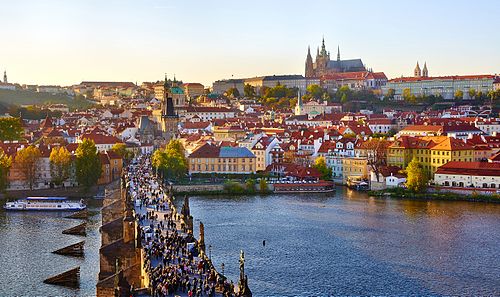
Prague Castle from Charles Bridge
Public domain (Wikimedia Commons)
| Population | 1.3 million (city) |
| Founded | Settled from 9th century; Prague Castle c. 880 |
| Language | Czech |
| Holy Roman capital | 14th century under Charles IV |
| Velvet Revolution | 1989 |
| Prague Castle | Largest ancient castle complex by area |
History
Medieval Prague and Charles IV
Prague was settled from the 9th century, with Prague Castle — the seat of Bohemian rulers — established around 880. The city flourished under Emperor Charles IV (reign 1346–1378), who made Prague the capital of the Holy Roman Empire and one of the most important cities in medieval Europe. Charles founded Charles University in 1348 — the oldest university in Central Europe — commissioned the Charles Bridge (completed 1402), and began the Gothic reconstruction of St Vitus Cathedral. Prague's Old Town received its famous Astronomical Clock (Orloj) in 1410.
Habsburg Rule and the Defenestrations
Prague gave Europe one of its most dramatic political gestures: the Defenestration of Prague. In 1419, Hussite protestors threw Catholic councillors from the Town Hall windows; in 1618, Protestant nobles threw Habsburg officials from Prague Castle — triggering the Thirty Years' War. After Protestant defeat at the Battle of White Mountain (1620), the Habsburgs imposed Counter-Reformation Catholic rule and Germanisation on Bohemia for three centuries.
Republic, Occupation, Communism
Czechoslovakia was founded in 1918 under philosopher-president Tomáš Masaryk — one of the few democratic states in interwar Central Europe. Nazi Germany occupied it in 1939; Operation Anthropoid — the assassination of Reinhard Heydrich by Czech paratroopers in Prague in 1942 — was one of the most daring Allied operations of the war. After WWII, the Communist Party seized power in 1948. The Prague Spring of 1968 — Alexander Dubček's "socialism with a human face" — ended when Soviet tanks rolled in on August 21. The Velvet Revolution of November 1989 peacefully ended communist rule; playwright Václav Havel became president.
Landmarks
Prague Castle
Prague Castle — a complex of palaces, churches, gardens, and courtyards stretching 570 metres — is the largest ancient castle complex in the world by area. Within its walls stands St Vitus Cathedral, a Gothic masterpiece containing the Crown Jewels of Bohemia and the tomb of St Wenceslas (Václav), Bohemia's patron saint and the subject of the Christmas carol.
Old Town Square and the Orloj
Old Town Square is the historic heart of Prague — surrounded by Gothic, Baroque, and Romanesque buildings. The Astronomical Clock (Orloj), installed in 1410, is one of the oldest functioning clocks of its kind. Every hour, figures of the Apostles appear in its windows as Death rings a bell. The square also contains the Jan Hus Memorial, honouring the Czech reformer burned at the Council of Constance in 1415 — a century before Luther.
Fast Facts
- Prague has the highest beer consumption per capita in the world (160 litres per person per year)
- The city was largely undamaged in WWII — unlike Warsaw, Dresden, or Berlin
- Franz Kafka was born in Prague in 1883 and spent most of his life here, writing in German
- Prague's Jewish Quarter (Josefov) has six historic synagogues — one of the most complete medieval Jewish heritage sites in Europe
- The Vltava river runs through the city; Smetana's symphonic poem Vltava (Moldau) is arguably the most famous piece of Czech music
📜 Notable Quote
"Prague never lets you go… this dear little mother has sharp claws."
Franz Kafka, in a letter to Oskar Pollak, 1902.
How well do you know the City of a Hundred Spires?
Put your knowledge to the test.
Take the Prague Quiz →