Vatican City: Capital of the Holy See
The smallest internationally recognised state on Earth — 0.44 km², 800 people, the world's oldest standing army, a ceiling painted standing up (not lying down), and a Pope whose actual cathedral is elsewhere.
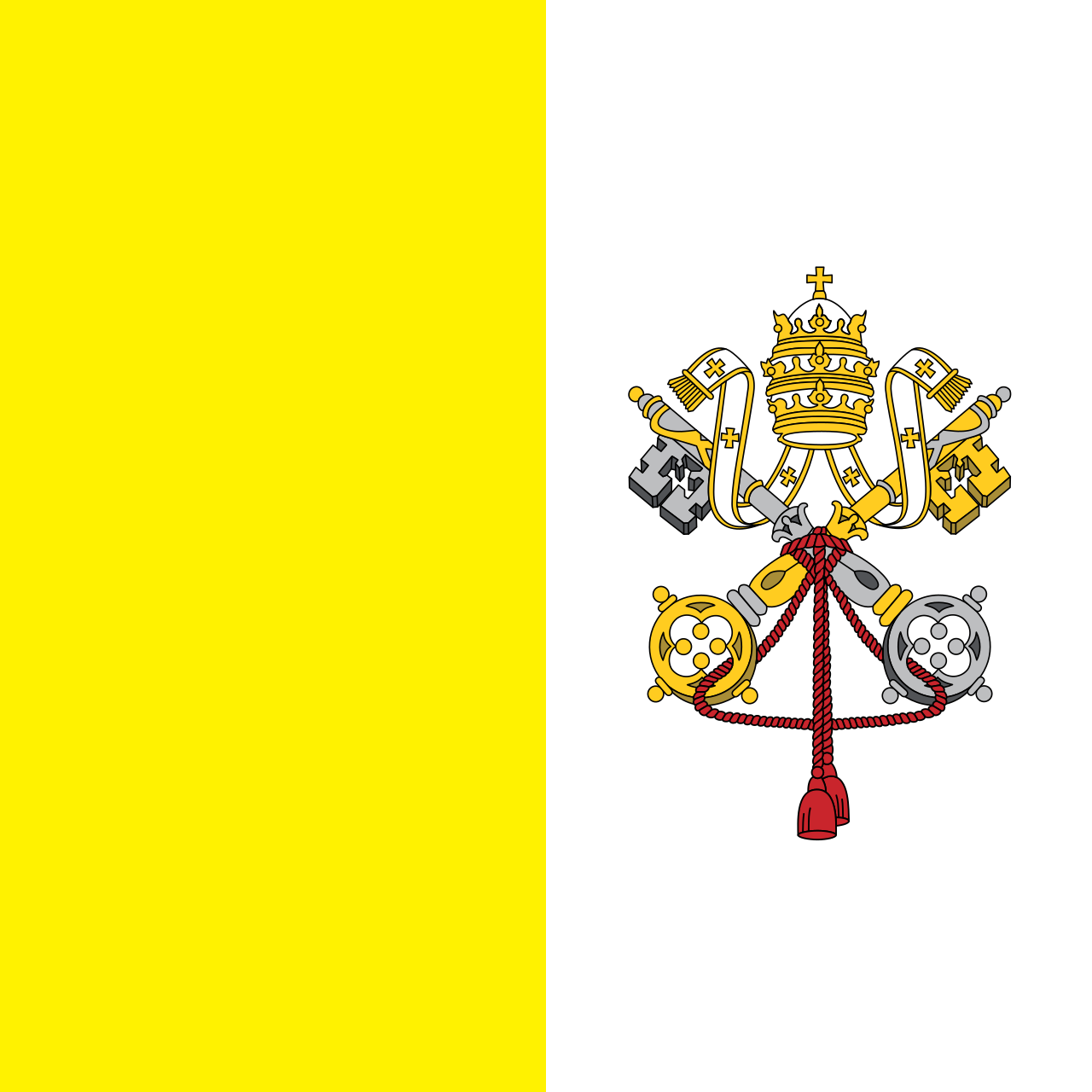
St Peter's Square, Vatican City
Public domain (Wikimedia Commons)
| Area | 0.44 km² — world's smallest state |
| Population | ~800 |
| Founded | 1929 (Lateran Treaty) |
| Army | Papal Swiss Guard (since 1506) |
| Currency | Euro (own Vatican coins) |
History
Created in 1929
Vatican City as a sovereign state is younger than many realise — created on 11 February 1929 by the Lateran Treaty, signed between the Holy See and Benito Mussolini's Italian government. Before that, the Pope ruled the much larger Papal States. When Italian unification swept through in 1870, troops took Rome and the Papal States ceased to exist. For 59 years, successive Popes refused to leave the Vatican buildings, considering themselves "prisoners of the Vatican." Mussolini resolved the deadlock by creating a new micro-state in exchange for the Church's recognition of Italy.
Over a Thousand Years of Significance
The site itself has been significant far longer. St Peter's tomb, the first Bishop of Rome, was venerated here from the earliest centuries of Christianity. Emperor Constantine built the first basilica over the site around 320 AD. The current St Peter's Basilica took over 100 years to build (1506–1626), involved Bramante, Raphael, Michelangelo, and Bernini, and remains the largest church in the world by interior volume.
Landmarks & Culture
St Peter's Basilica — Not a Cathedral
A fact that surprises many visitors: St Peter's Basilica is NOT a cathedral. A cathedral is a church that contains the bishop's chair (cathedra). The Pope's actual cathedral, where he sits as Bishop of Rome, is the Basilica of St John Lateran, several kilometres away in Rome proper. St Peter's is a papal basilica — the site of major ceremonies and papal burials — but technically not the highest-ranking church even in Catholicism.
Sistine Chapel — Painted Standing, Not Lying
Michelangelo painted the Sistine Chapel ceiling between 1508 and 1512 — and he painted it standing up on scaffolding he designed himself, not lying on his back as popular myth insists. He worked with his head tilted sharply back and complained bitterly, writing a poem mocking his own contorted posture. The ceiling covers 500 square metres and contains over 300 figures.
The Papal Swiss Guard
Founded by Pope Julius II in 1506, the Papal Swiss Guard is the world's oldest standing army still in active operation. Guards must be Swiss, Catholic, male, unmarried, and at least 174 cm tall. The striped ceremonial uniform is often attributed to Michelangelo's design — though historians dispute this.
Fast Facts
- Smallest internationally recognised state in the world: 0.44 km² — roughly 60 football pitches.
- Michelangelo painted the Sistine Chapel ceiling standing, not lying down.
- St Peter's Basilica is not a cathedral — the Pope's actual cathedral is St John Lateran in Rome.
- Vatican City has its own post office, radio station (45 languages), pharmacy, bank, and railway station.
- Vatican issues its own highly collectible euro coins.
📊 Vatican City in Numbers
- 0.44 km² — smallest sovereign state on Earth
- ~800 residents — smallest population of any sovereign state
- 520 years of the Swiss Guard (1506–present)
- 59 years the Pope refused to leave after losing the Papal States (1870–1929)
- 300+ figures painted by Michelangelo on the Sistine Chapel ceiling