Valletta: Capital of Malta
The smallest EU capital by both area and population — built in a hurry by crusading knights after a siege, home to a Caravaggio signed in blood, and surrounded by megalithic temples older than the pyramids.
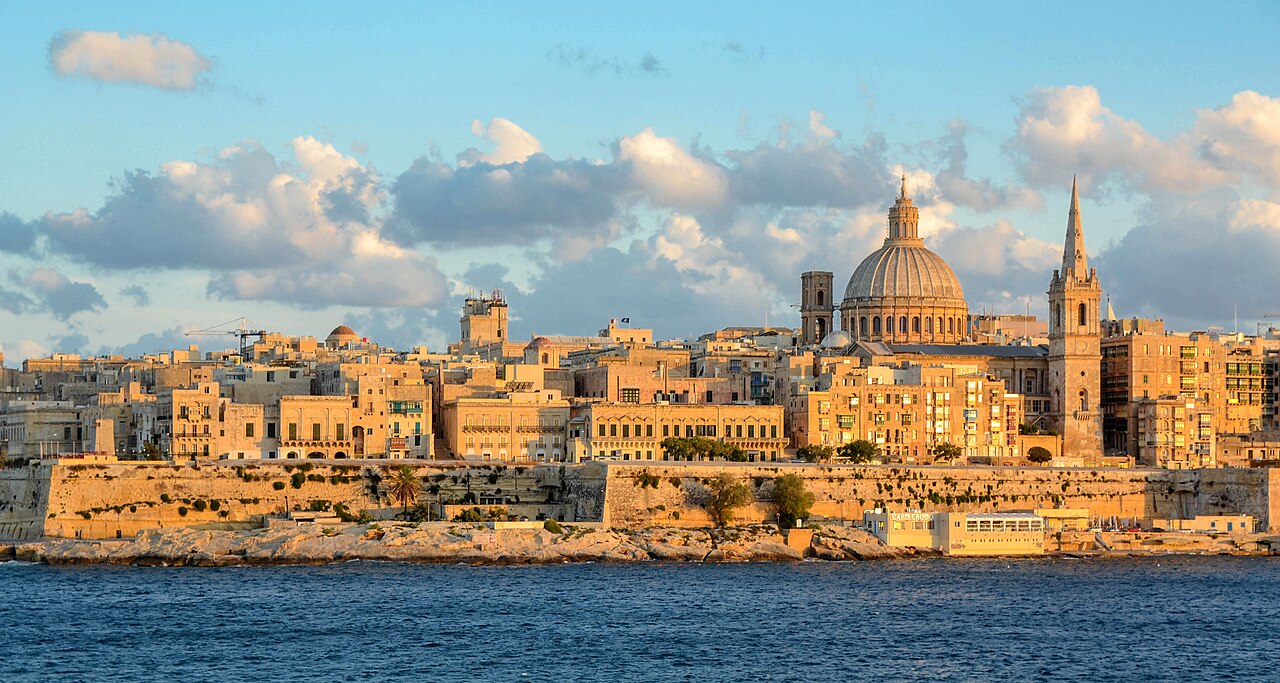
The Grand Harbour, Valletta
Public domain (Wikimedia Commons)
| Population | ~6,000 (city); 520,000 (country) |
| Area | 0.8 km² — smallest EU capital by area |
| Founded | 1566 by the Knights of St John |
| Languages | Maltese + English (both official) |
| UNESCO | World Heritage Site since 1980 |
History
Built After a Siege
Valletta owes its existence to one of history's most dramatic military confrontations. In 1565, the Ottoman Empire launched the Great Siege of Malta — deploying between 30,000 and 40,000 troops against the island's defenders: roughly 700 Knights of St John and about 8,000 Maltese soldiers and civilians. The siege lasted four months. The Knights, led by Grand Master Jean de Valette, held on until a Spanish relief force arrived in September. The Ottomans retreated. The Knights immediately resolved never to be caught so poorly fortified again. Within a year, on March 28, 1566, de Valette laid the first stone of a new fortified city — named Valletta in his honour — designed from scratch on a grid plan by military engineer Francesco Laparelli.
The Most Bombed Place in WWII
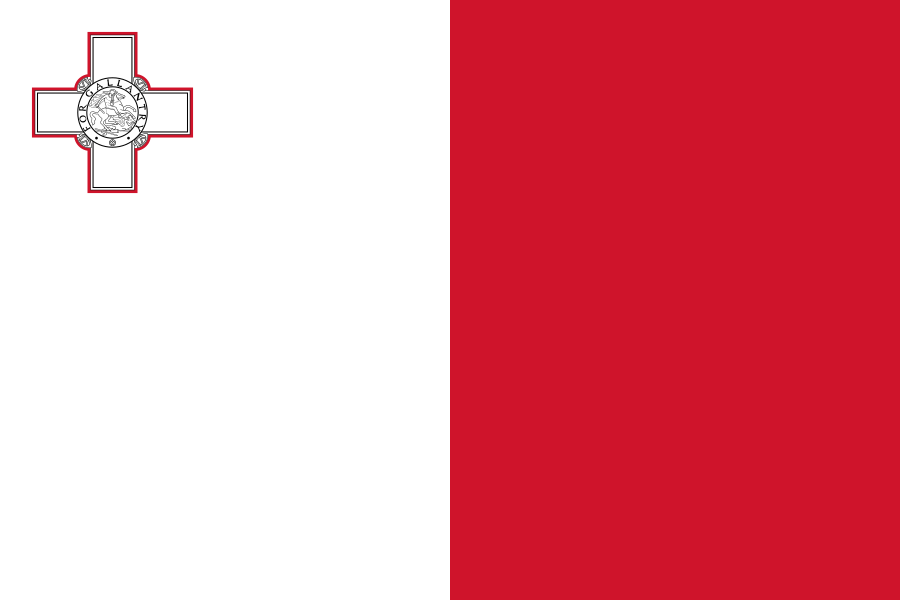
During World War II, Malta's strategic position in the centre of the Mediterranean made it vital to Allied supply lines to North Africa — and a constant target for Axis bombing. Between 1940 and 1942, Malta endured over 3,000 air raids. In the first six months of 1942 alone, more bombs were dropped on Malta than on London during the entire Blitz. Malta became the most heavily bombed place per square kilometre in the war. In April 1942, King George VI awarded the entire island of Malta the George Cross — an honour normally given to individuals — in recognition of its people's extraordinary resilience.
Knights, Baroque, and a Caravaggio
The Knights of St John were not merely soldiers — they were patrons of the arts, and Valletta's St John's Co-Cathedral (1578) is one of the most extraordinary baroque interiors in Europe: every inch of floor covered with the polychrome marble tombstones of 375 knights, the walls and ceiling covered in gilded carvings and frescoes. The cathedral houses Caravaggio's Beheading of St John the Baptist (1608) — the largest painting the artist ever produced and, notably, the only painting Caravaggio ever signed. He signed it in the blood pooling beneath St John's severed head: f. Michel A. (fra Michel Angelo — Brother Michel Angelo).
Landmarks & Culture
Prehistoric Malta — Older Than the Pyramids
Malta's most remarkable heritage predates Valletta by thousands of years. The Ħaġar Qim and Mnajdra megalithic temples, built between 3600 and 2500 BC, are among the oldest freestanding structures in the world — older than Stonehenge and older than the Egyptian pyramids. The Hypogeum of Ħal Saflieni — an underground prehistoric necropolis carved into rock — dates to around 4000 BC and is a UNESCO World Heritage Site. Malta was one of the most densely inhabited places in the ancient Mediterranean world.
European Capital of Culture 2018
Despite its tiny size, Valletta was designated European Capital of Culture in 2018, sharing the honour with Leeuwarden (Netherlands) and Lviv (Ukraine). The designation triggered major investment in arts infrastructure, the restoration of historic buildings, and a year-long programme of cultural events. The MUŻA (Museum of Fine Arts) and the Valletta Design Cluster were among the lasting legacies of 2018.
Fast Facts
- Valletta covers just 0.8 km² — smaller than many city parks — yet contains more monuments per square metre than anywhere else in Europe
- The George Cross awarded to Malta in 1942 appears on the Maltese flag to this day
- Maltese is the only Semitic language written in the Latin alphabet and an official EU language
- Malta was under continuous British rule from 1800 to 1964 — hence English remaining an official language
- The island's megalithic temples predate Stonehenge by 1,000 years and the Egyptian pyramids by at least 500 years
📊 Malta in Numbers
- 0.8 km² — the area of Valletta, smallest capital in the EU
- 3,000+ air raids endured by Malta during WWII — the most bombed place per km² in the war
- 3600–2500 BC — age of Ħaġar Qim temples, older than Stonehenge and the pyramids
- 1 — the number of paintings Caravaggio ever signed, now hanging in Valletta's St John's Co-Cathedral
How well do you know Europe's smallest capital?
Put your knowledge to the test.
Take the Valletta Quiz →