Reykjavik: Capital of Iceland
The world's northernmost capital, home to the oldest parliament on earth, the first democratically elected female president, and the only city where you can watch the Northern Lights from your bedroom window.
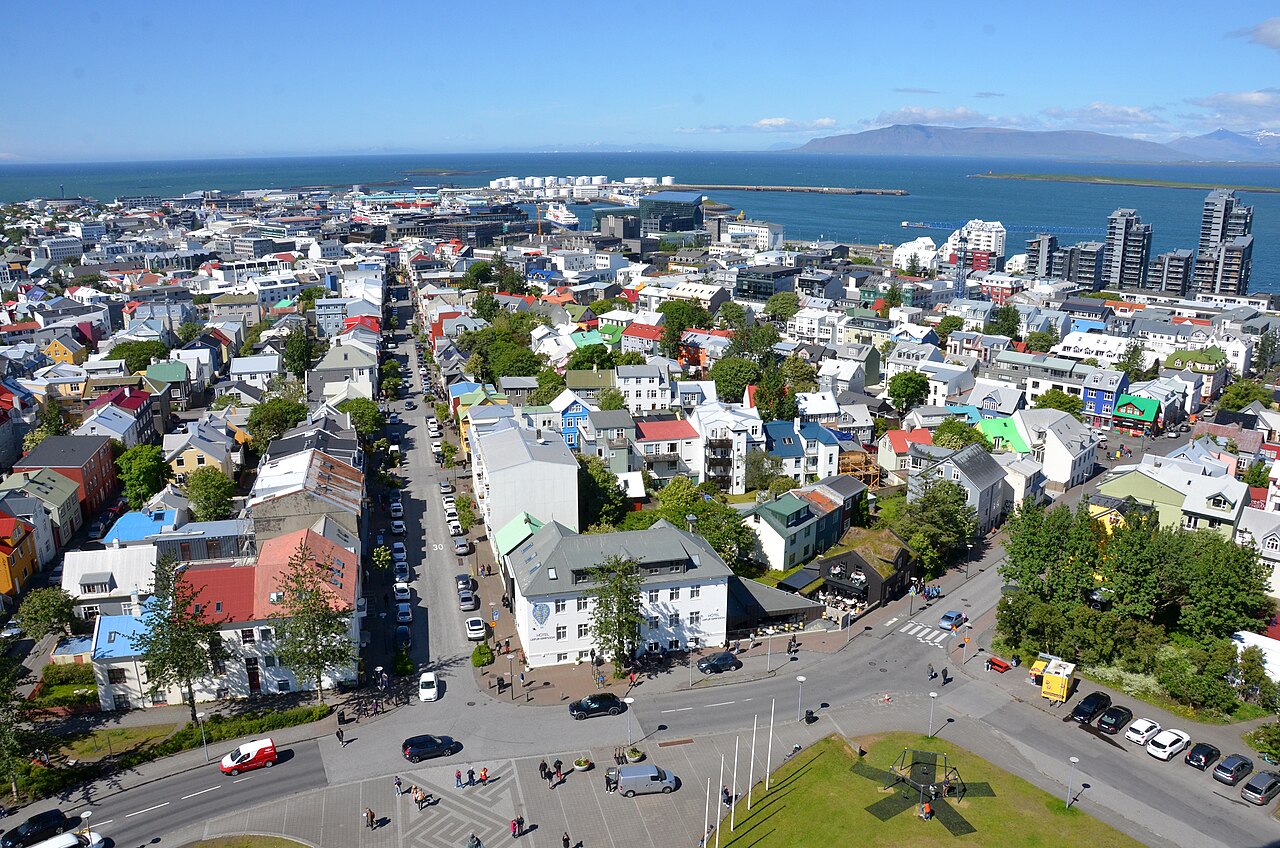
Hallgrímskirkja — Reykjavik's landmark church
Public domain (Wikimedia Commons)
| Population | 130,000 (city); 376,000 (country) |
| Founded | 874 AD by Norse settler Ingólfr Arnarson |
| Parliament | Althing (founded 930 AD — world's oldest) |
| Energy | 100% renewable (geothermal + hydro) |
| Position | World's northernmost capital city |
History
The World's Oldest Parliament
According to the Landnámabók (Book of Settlements), the first permanent Norse settler in Iceland was Ingólfr Arnarson, who arrived in 874 AD and named his settlement Reykjavík — "Smoky Bay" — after the geothermal steam rising from hot springs. Within decades, Iceland had attracted thousands of Norwegian settlers escaping the centralising power of King Harald Fairhair. In 930 AD, these settlers established the Althing (Alþingi) at Þingvellir — an outdoor assembly of chieftains that met each summer to make laws, settle disputes, and conduct trade. The Althing is considered the world's oldest parliament, predating England's Parliament by more than 250 years, and it has operated — with a brief interruption — continuously ever since.
A World First: The First Female President
On June 29, 1980, Iceland elected Vigdís Finnbogadóttir as President — making her the first woman in the world to be democratically elected head of state. A theatre director and French teacher with no prior political career, she won 33.6% of the vote in a four-candidate race and went on to serve four terms until 1996. Her election was not positioned as a political milestone — she simply ran as the most qualified candidate. She remains one of the longest-serving elected female heads of state in history.
Reagan, Gorbachev, and the Summit That Nearly Ended the Cold War
In October 1986, US President Ronald Reagan and Soviet General Secretary Mikhail Gorbachev met at Höfði House in Reykjavik for what became the most dramatic arms control summit of the Cold War. Over two days, the two leaders came closer to agreeing on total nuclear disarmament than any leaders had before or since. The summit ultimately failed over Reagan's refusal to limit the Strategic Defense Initiative ("Star Wars"), but it broke the Cold War stalemate and led directly to the INF Treaty (1987) — the first treaty to eliminate an entire class of nuclear weapons.
Landmarks & Culture
Hallgrímskirkja
Reykjavik's skyline is dominated by Hallgrímskirkja, a Lutheran church 74.5 metres tall — the tallest structure in Iceland. Designed by architect Guðjón Samúelsson to evoke the columnar basalt rock formations created by Iceland's volcanic geology, it took 41 years to build (1945–1986). The church is visible from almost anywhere in the city and houses a massive 5,275-pipe Klais organ. The tower observation deck offers panoramic views over Reykjavik's colourful corrugated-iron rooftops and, on clear days, to the mountains and glaciers beyond.
Geothermal Capital
Reykjavik is one of the cleanest capitals in the world, heated almost entirely by geothermal energy piped directly from hot springs beneath the city. Iceland generates 100% of its electricity from renewable sources — geothermal and hydropower. The aurora borealis (Northern Lights) is regularly visible from the city itself on clear winter nights — a phenomenon unimaginable in any other European capital.
Fast Facts
- Reykjavik is the world's northernmost capital city, at 64°N latitude
- Iceland has no army — it is one of the few sovereign states without a military force
- The country has the world's highest literacy rate and publishes more books per capita than any other nation
- Iceland is one of the world's most active volcanic regions — the island is still growing as lava flows into the sea
- Despite the name, Greenland is icy and Iceland is green — the misleading names may have been deliberate Viking marketing to confuse rivals
📊 Iceland in Numbers
- 930 AD — the Althing was founded, making it the world's oldest parliament
- 1980 — Vigdís Finnbogadóttir became the first democratically elected female president in history
- 100% of Iceland's electricity comes from renewable sources
- 74.5 m — the height of Hallgrímskirkja, Iceland's tallest structure, visible from across Reykjavik
How well do you know the world's northernmost capital?
Put your knowledge to the test.
Take the Reykjavik Quiz →