Tirana: Capital of Albania
Founded by an Ottoman general in 1614, isolated behind 750,000 concrete bunkers for half a century, and now one of Europe's fastest-growing and most colourful capitals.
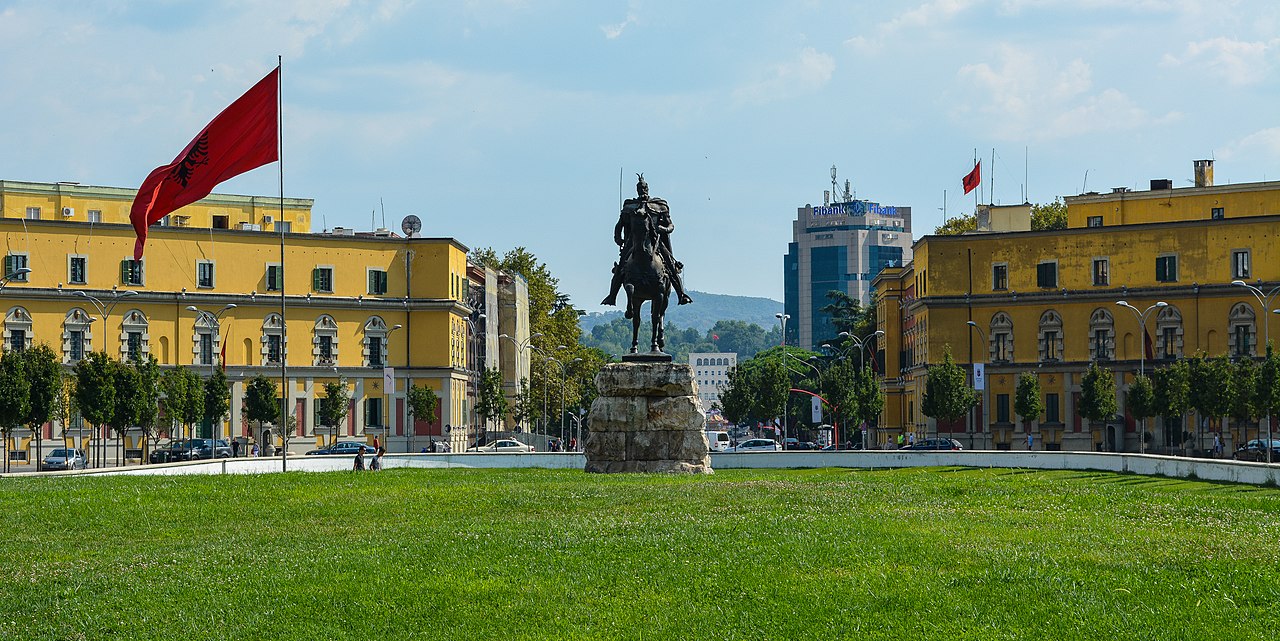
Skanderbeg Square, Tirana
Public domain (Wikimedia Commons)
| Population | ~800,000 (city, rapidly growing) |
| Founded | 1614 by Ottoman general Bargjini |
| Capital since | 1920 |
| Communist bunkers | ~750,000 built under Hoxha |
| Isolation ended | 1990–91 |
| NATO member | 2009 |
History
From Ottoman Village to Capital
Tirana was founded in 1614 by the Ottoman general Sulejman Pasha Bargjini, who built a mosque, a bakery, and a hamam (bathhouse) here — the nucleus of what would grow into a town. For most of the Ottoman period it was a minor market town, known for olive oil and soap production. Albania declared independence in 1912 following the First Balkan War, and after years of turbulent politics, Tirana was designated the national capital in 1920 at the Congress of Lushnjë — not because it was the largest or most historically significant city, but because its central location made it acceptable to competing regional factions.
Enver Hoxha's Bunker State: The Most Isolated Country in the World
From 1944 to 1990, Albania was ruled by Enver Hoxha — one of history's most extreme communist dictators. He broke with Yugoslavia in 1948, the Soviet Union in 1961, and China in 1978, leaving Albania in complete international isolation. Albania was the only country in the world to constitutionally ban religion (1967) — mosques, churches, and monasteries were destroyed or repurposed. Hoxha's most visible legacy is the network of ~750,000 concrete bunkers he ordered built across the country between 1967 and 1986 — one for roughly every four Albanians — designed to defend against an invasion that never came. Albania was the last European country to get television (1971), and ordinary Albanians had almost no contact with the outside world for nearly five decades.
Collapse and Rapid Transformation
When the communist regime collapsed in 1990–91, Albania experienced one of the most dramatic transformations in modern European history. The population of Tirana tripled in a decade as rural Albanians flooded into the city. In 1997, the collapse of fraudulent pyramid investment schemes plunged the country into near-civil war; the army's weapons depots were looted and an estimated one million firearms entered circulation. Recovery was slow but remarkable. In the 2000s, Tirana's chaotic informal construction was tackled by mayor Edi Rama (later Prime Minister), who ordered the city's grey communist blocks painted in vivid colours and patterns — a programme that attracted international attention and helped transform the city's image.
Landmarks & Culture
Blloku: From Communist Elite Zone to Trendy Quarter
The Blloku quarter — literally "the Block" — was under communism a walled residential zone for Albania's ruling elite, accessible only to senior party officials. Ordinary Albanians were forbidden from entering on pain of imprisonment. After 1991, the barriers came down and Blloku transformed into Tirana's trendiest district, packed with cafés, bars, boutiques, and restaurants. Hoxha's former villa stands here, partially converted into a museum. The contrast between its communist past and its current role as Tirana's social heart is one of the city's most striking stories.
Fast Facts
- Albania's national hero Skanderbeg (Gjergj Kastrioti, 1405–1468) resisted Ottoman conquest for 25 years; his helmet-and-goat monument dominates Tirana's central square
- Hoxha's bunkers are now being repurposed as cafés, art studios, storage units, and tourist attractions
- Albania was the last country in Europe to get television — state TV launched in 1971
- Tirana has tripled in size since 1990 — one of Europe's fastest-growing capitals
- The Albanian word for "yes" is po and for "no" is jo — but many Albanians traditionally nod for "no" and shake their head for "yes", the opposite of most cultures
📊 Albania in Numbers
- Population: ~2.8 million (though emigration is high; the diaspora numbers several million more)
- Area: 28,748 km²
- Albania joined NATO in 2009 and is an EU candidate country
- Approximately 750,000 bunkers were built — roughly one for every 4 inhabitants at the time
- Albanian is a language isolate within Indo-European — not closely related to any other European language