Skopje: Capital of North Macedonia
Rebuilt after a devastating earthquake, then controversially covered in baroque monuments — Skopje is the most unusual capital in the Balkans, and possibly in all of Europe.
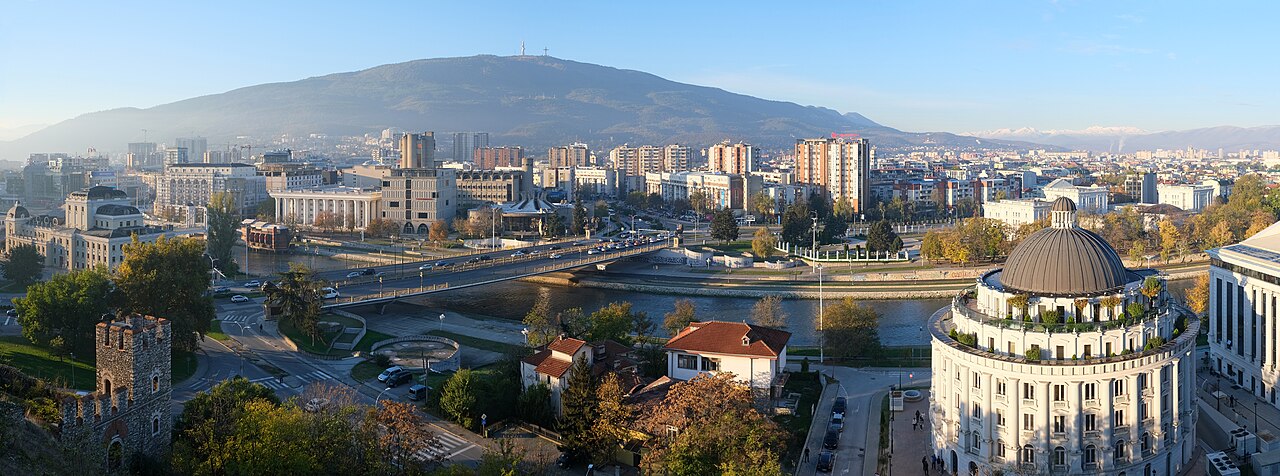
Stone Bridge and Skopje old town
Public domain (Wikimedia Commons)
| Population | ~600,000 (metro area) |
| 1963 earthquake | 80% of city destroyed |
| Skopje 2014 cost | ~€500 million in monuments |
| Old Bazaar | Čaršija — one of largest in Balkans |
| Notable birthplace | Mother Teresa (1910, then Ottoman) |
| NATO member | 2020 |
History
Ancient Scupi and Medieval Kingdom
The area around Skopje has been inhabited since prehistoric times. The Romans built a major city called Scupi here in the 1st century AD, and its ruins can be seen on the western outskirts of the modern city. Skopje later became part of the medieval Bulgarian and Serbian empires — under the Serbian Emperor Stefan Dušan in the 14th century, it was the capital of the largest Balkan state of the medieval period. Ottoman forces captured it in 1392, and it remained under Ottoman rule for over five centuries, developing a substantial Turkish-influenced old bazaar (Čaršija) that survives today as one of the largest and most authentic in the Balkans.
The 1963 Earthquake: Rebuilt by the World
On July 26, 1963, a 6.9-magnitude earthquake struck Skopje at 5:17 in the morning. Over 80% of the city was destroyed, more than 1,000 people were killed, and 200,000 were left homeless. The disaster prompted an extraordinary international response — over 70 countries sent aid and building materials. Japanese architect Kenzo Tange was commissioned to design the new city plan. The resulting modernist urban layout — with its wide boulevards, brutalist railway station (preserved as a museum), and new residential districts — is still the skeleton of today's Skopje. The clock on the ruined old railway station is frozen at 5:17 AM, the moment the earthquake struck.
Skopje 2014: The Controversial Baroque Makeover
In 2010, the government launched Skopje 2014 — an ambitious and deeply controversial urban redesign project aimed at giving the city a grander, more "historic" European identity. Over the following years, central Skopje was filled with neo-baroque and neo-classical buildings, fountains, and over 130 statues — including a towering monument to Alexander the Great (officially called "Warrior on a Horse" to avoid antagonising Greece, which disputed the Alexander the Great heritage claim). The project cost an estimated €500 million and divided the country — critics called it kitsch authoritarian spectacle; supporters saw it as national identity-building. The result is genuinely unlike any other European capital.
Landmarks & Culture
The Old Bazaar (Čaršija) and the Stone Bridge
Skopje's Old Bazaar — the Čaršija — is one of the largest and best-preserved Ottoman bazaars in the Balkans, with hundreds of craft workshops, mosques, hans (caravanserais), and tea houses. It is separated from the new city by the Stone Bridge (Kameni Most), a 15th-century Ottoman bridge of 13 arches across the Vardar River. The contrast between the Ottoman bazaar on one side and the neo-baroque monuments on the other side of the bridge captures the fundamental tension of modern Skopje perfectly.
Fast Facts
- Mother Teresa was born in Skopje in 1910 when it was part of the Ottoman Empire; her memorial house stands in the city centre
- North Macedonia was known as FYROM (Former Yugoslav Republic of Macedonia) from 1991 to 2019 due to a naming dispute with Greece, resolved by the Prespa Agreement
- The Matka Canyon — 15 km from Skopje — has the highest concentration of caves in North Macedonia, including Vrelo Cave with 88 metres of explored underwater tunnels
- North Macedonia joined NATO in 2020 — resolving a three-decade dispute with Greece over the country's name
- The Vardar river flows through Skopje and eventually empties into the Aegean Sea in Greece
📊 North Macedonia in Numbers
- Population: ~2 million
- Area: 25,713 km²
- North Macedonia borders 5 countries: Greece, Bulgaria, Serbia, Kosovo, and Albania
- The country gained independence from Yugoslavia in 1991 — one of the few Yugoslav republics to do so without armed conflict
- North Macedonia is a candidate for EU membership; accession negotiations began in 2022