Thomas Jefferson: The Brilliant Contradiction
Author of the Declaration of Independence, architect of American liberty — and enslaver of over 600 people. No Founder is more celebrated or more contradicted.
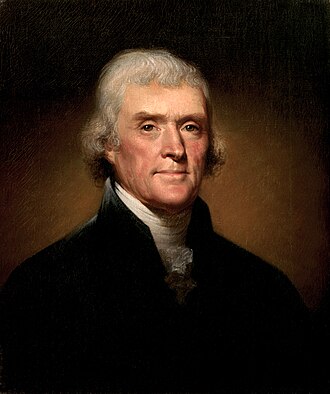
Rembrandt Peale, 1800
Public domain
| Born | April 13, 1743 — Shadwell, Virginia |
| Died | July 4, 1826 — Monticello, Virginia (age 83) |
| Presidency | 3rd President, March 4, 1801 – March 4, 1809 |
| Party | Democratic-Republican |
| Spouse | Martha Wayles Skelton (m. 1772, d. 1782) |
| Profession | Lawyer, architect, philosopher, planter |
Early Life and Family
Thomas Jefferson was born on April 13, 1743 at Shadwell plantation in Virginia's Piedmont region. His father, Peter Jefferson, was a surveyor and planter; his mother, Jane Randolph, came from one of Virginia's most prominent families. Jefferson studied at the College of William & Mary and read law under George Wythe, one of America's first law professors. He was curious about everything — architecture, music, natural history, linguistics, wine — and pursued all of it with obsessive intensity.
His wife Martha died in 1782 after ten years of marriage, leaving Jefferson devastated. He never remarried. His relationship with Sally Hemings — an enslaved woman at Monticello who was also Martha's half-sister — produced at least six children, a fact confirmed by DNA evidence in 1998 and now accepted by most historians. Jefferson freed none of them during his lifetime.
Before the Presidency
The Declaration of Independence
In 1776, the 33-year-old Jefferson was assigned to draft the Declaration of Independence. In seventeen days he produced one of the most influential documents in human history: "We hold these truths to be self-evident, that all men are created equal..." The committee made revisions — most notably cutting Jefferson's denunciation of the slave trade — but the core prose was his. The document announced a new philosophy of government to the world.
Governor, Diplomat, Secretary of State
Jefferson served as Governor of Virginia during the Revolution, fled the British advance in 1781 (an episode that haunted him), and then spent five years as U.S. Minister to France. Back home, he served as Washington's Secretary of State before resigning in 1793 over clashes with Hamilton. He and Hamilton represented two fundamentally different visions of America — agrarian republic vs. commercial nation — that still echo in American politics today.
The Presidency (1801–1809)
What He Built
- Louisiana Purchase (1803): Jefferson bought roughly 828,000 square miles from France for $15 million — doubling the size of the United States at about 3 cents per acre. He had no constitutional authority to do it and knew it, but did it anyway.
- Lewis and Clark Expedition (1804–06): Jefferson commissioned Meriwether Lewis and William Clark to explore the new western territory — one of the great scientific and geographic expeditions in American history.
- Embargo Act (1807): Banned American trade with Europe to keep the U.S. out of the Napoleonic Wars. It was economically disastrous but kept the country out of war.
- Abolished the Atlantic slave trade (1807): Jefferson signed the Act Prohibiting Importation of Slaves — banning the import of enslaved people from Africa, though domestic slavery continued.
Controversies and Failures
- Slavery: Jefferson enslaved over 600 people throughout his life, freeing only a handful. He wrote that slavery was a "moral and political depravity" while benefiting from it enormously and doing nothing to end it.
- Sally Hemings: Jefferson fathered children with an enslaved woman he legally owned. He never acknowledged them publicly.
- Embargo disaster: The 1807 embargo devastated New England's economy and was widely evaded. Jefferson repealed it three days before leaving office.
Death
Jefferson died on July 4, 1826 at Monticello — the same day as John Adams, the 50th anniversary of independence. He was 83. He died deeply in debt, and his enslaved workers — including Sally Hemings's children — were sold to pay his creditors. His last words were reportedly "Is it the Fourth?"
📜 Notable Quote
"I cannot live without books."
Letter to John Adams, 1815. Jefferson's library of 6,487 books formed the nucleus of the Library of Congress after the British burned Washington in 1814.
Legacy and Writings
Jefferson's writings are extraordinary in range: the Declaration of Independence, the Statute of Virginia for Religious Freedom, his autobiography, and tens of thousands of letters. He founded the University of Virginia and designed its campus himself. He considered his three greatest achievements — not his presidency — to be the Declaration, the Virginia Statute, and founding the University.
📊 How History Rates Thomas Jefferson
- C-SPAN Historians Survey (2021): Ranked #7
- Siena College Research Institute (2022): Ranked #5
Jefferson's rankings have been falling as historians give greater weight to his enslavement of hundreds of people. He was ranked #2 in earlier surveys; the contradiction between his words and his actions is now seen as central to his legacy, not a footnote.
How well do you know the third president?
Put your knowledge to the test.
Take the Thomas Jefferson Quiz →