John Adams: The Indispensable Patriot
Brilliant, stubborn, and chronically underappreciated — the man who kept America out of a catastrophic war and died on the perfect day.
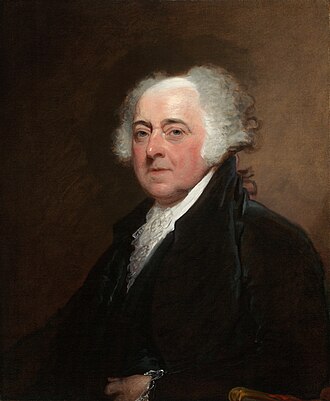
Gilbert Stuart, c. 1800
Public domain
| Born | October 30, 1735 — Braintree, Massachusetts |
| Died | July 4, 1826 — Quincy, Massachusetts (age 90) |
| Presidency | 2nd President, March 4, 1797 – March 4, 1801 |
| Party | Federalist |
| Spouse | Abigail Smith (m. 1764) |
| Profession | Lawyer, diplomat, statesman |
Early Life and Family
John Adams was born on October 30, 1735 in Braintree, Massachusetts, into a family of modest but respectable Puritan stock. His father, a farmer and shoemaker, expected John to enter the ministry — but Adams instead pursued law, graduating from Harvard in 1755. He was bookish, argumentative, and possessed of a ferocious ego that he spent his entire life trying to keep in check with varying success.
In 1764 he married Abigail Smith, one of the most remarkable women of the founding era. Their 54-year correspondence is a treasure of American letters — Abigail's letters from the home front while John was in Philadelphia and Europe reveal a sharp political mind equal to her husband's. She famously urged him to "remember the ladies" when drawing up the new laws.
Before the Presidency
The Boston Massacre Defence
In 1770, Adams made the most principled and politically costly decision of his early career: he agreed to defend the British soldiers accused in the Boston Massacre. Despite the enormous public pressure to condemn them, Adams secured acquittals or reduced charges for most of the men, arguing that even unpopular defendants deserved a fair trial. It nearly destroyed his reputation — and he considered it one of the finest things he ever did.
Continental Congress and the Revolution
Adams was a central force at the Continental Congress, arguing passionately for independence and nominating George Washington as commander of the Continental Army. He served on the committee to draft the Declaration of Independence, though Jefferson did the actual writing. Adams spent years in Europe as a diplomat — in France, the Netherlands, and Britain — negotiating the treaty that ended the Revolutionary War.
The Presidency (1797–1801)
What He Built
- Kept the United States out of full-scale war with France during the Quasi-War (1798–1800) — a naval conflict that easily could have escalated. His decision to negotiate peace cost him re-election but saved the young republic enormous damage.
- Established the U.S. Navy as a permanent institution, founding the Department of the Navy in 1798.
- Appointed John Marshall as Chief Justice of the Supreme Court — arguably the most consequential judicial appointment in American history. Marshall shaped constitutional law for 34 years.
Controversies and Failures
- Alien and Sedition Acts (1798): Adams signed four laws restricting immigration and criminalising criticism of the government. Historians widely regard them as unconstitutional overreach and a low point of his presidency.
- XYZ Affair: French agents demanded bribes before negotiations could begin. Adams's public disclosure of this outrage inflamed anti-French sentiment — but he still chose diplomacy over war.
- Rift with Hamilton: His own party, led by Alexander Hamilton, actively worked against him in 1800. Adams lost re-election to Jefferson by just a handful of electoral votes.
Death
Adams lived to 90 — the longest-lived president until Ronald Reagan. On July 4, 1826, the 50th anniversary of American independence, Adams lay dying at his home in Quincy. His reported last words were "Thomas Jefferson survives" — not knowing that Jefferson had died at Monticello just hours earlier. Both Founding Fathers died on the same day, fifty years to the day after independence. The nation was stunned.
📜 Notable Quote
"Facts are stubborn things; and whatever may be our wishes, our inclinations, or the dictates of our passion, they cannot alter the state of facts and evidence."
From his closing argument defending the British soldiers in the Boston Massacre trial, 1770.
Legacy and Writings
Adams was a prolific writer — his Defence of the Constitutions of Government of the United States (1787) was a serious work of political philosophy. His correspondence with Jefferson, resumed after a long estrangement, is one of the greatest intellectual exchanges in American history. He never owned enslaved people — one of the very few Founders of whom this can be said.
📊 How History Rates John Adams
- C-SPAN Historians Survey (2021): Ranked #19
- Siena College Research Institute (2022): Ranked #14
Historians increasingly rehabilitate Adams — his refusal to start a war with France, despite enormous political pressure, is now seen as one of the most courageous acts of any president. He sacrificed his re-election to keep the peace.