George Washington: Father of a Nation
Commander-in-chief, first president, reluctant icon. The man who could have been king — and chose not to be.
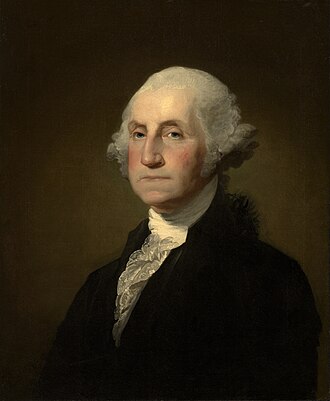
Gilbert Stuart, c. 1796
Public domain (Wikimedia Commons)
| Born | February 22, 1732 — Westmoreland County, Virginia |
| Died | December 14, 1799 — Mount Vernon, Virginia (age 67) |
| Presidency | 1st President, April 30, 1789 – March 4, 1797 |
| Party | Unaffiliated (favoured no party) |
| Spouse | Martha Dandridge Custis (m. 1759) |
| Profession | Soldier, surveyor, planter |
Early Life and Family
George Washington was born on February 22, 1732 on a tobacco farm in Westmoreland County, Virginia. His father, Augustine Washington, was a moderately prosperous planter; his mother, Mary Ball Washington, was known as demanding and domineering — a woman George had a famously strained relationship with throughout his life. Augustine died when George was just eleven, leaving him without a university education. While his older half-brothers studied in England, George educated himself, learning mathematics and surveying through practical work.
He grew up on Ferry Farm near Fredericksburg, and later inherited Mount Vernon from his half-brother Lawrence. Washington was physically imposing — contemporary accounts describe him as 6 feet 2 inches tall, unusually large for the era, with exceptional strength and riding ability. He suffered from smallpox at 19 (surviving with a lifelong pockmarked face), malaria, dysentery, tuberculosis, and various other illnesses that plagued him for decades.
Before the Presidency
Surveyor and Land Speculator
Washington first made his name as a surveyor. At 16, he joined a survey party mapping the Shenandoah Valley for Lord Fairfax. The work introduced him to the frontier and sparked a lifelong interest in western land speculation — Washington would eventually own over 60,000 acres across multiple territories.
The French and Indian War
In 1753, Governor Dinwiddie of Virginia sent the 21-year-old Washington into the Ohio Valley to warn the French to withdraw from British-claimed territory. The French refused, and Washington's subsequent military expedition triggered the opening shots of the French and Indian War (1754–1763). Washington survived two battles in which his horses were shot from under him and his coat was pierced by four bullets — emerging as a colonial hero despite the military disasters he partly caused.
Virginia Planter and Politician
After the war, Washington married the wealthy widow Martha Dandridge Custis in 1759. Their marriage was comfortable and loyal, though Martha's biographers note it was a practical union rather than a passionate romance. Washington became one of Virginia's wealthiest planters, running Mount Vernon with the labour of over 300 enslaved people at the time of his death — a fact that defines the moral complexity of his legacy.
He served in the Virginia House of Burgesses from 1758 and became increasingly radicalised against British taxation, joining the Continental Congress as growing tensions turned toward revolution.
The Revolutionary War
In June 1775, the Continental Congress appointed Washington Commander-in-Chief of the Continental Army. He was not the most experienced general available, but he was trusted, composed, and politically acceptable across all colonies. His leadership was rarely brilliant in the conventional military sense — he lost more battles than he won — but it was psychologically unshakeable.
His most celebrated moments came in desperation: the surprise crossing of the Delaware River on December 26, 1776, attacking sleeping Hessian troops at Trenton after a series of humiliating defeats. Then the brutal winter at Valley Forge (1777–78), where Washington kept an army of 12,000 men together through cold, disease, and near-starvation through force of will. The war culminated in the Siege of Yorktown in 1781, where Washington trapped Cornwallis's army with French naval support and effectively ended major British resistance.
The Presidency (1789–1797)
Washington was unanimously elected president by the Electoral College — the only president in American history to receive 100% of electoral votes, and he did it twice. He was reluctant to serve; he genuinely preferred retirement at Mount Vernon. His acceptance was itself a statement of civic duty over personal interest.
What He Built
- Established the Cabinet system — a body of department heads as executive advisors, now a fundamental part of American governance
- Supported the creation of the First National Bank (proposed by Hamilton), setting the precedent for federal economic management despite fierce opposition from Jefferson
- Signed the Proclamation of Neutrality (1793), keeping the U.S. out of the French Revolutionary Wars and setting the tone for American foreign policy for generations
- Established the two-term precedent by voluntarily stepping down in 1797 — a norm that held until FDR in 1940 and was written into law by the 22nd Amendment in 1951
- Delivered the Farewell Address of 1796, warning against political parties ("factions"), permanent alliances with foreign nations, and sectionalism — a document still quoted today
Controversies and Failures
- Slavery: Washington enslaved 317 people at Mount Vernon at the time of his death. While he privately expressed unease about slavery and made provisions to free his enslaved workers upon Martha's death (she freed them early, in 1801), he never used his enormous political influence to move against the institution during his presidency.
- The Whiskey Rebellion (1794): Washington personally led a 13,000-man militia force to crush a tax revolt in western Pennsylvania — the only time a sitting U.S. president has personally commanded troops in the field. Critics saw it as an overreach of federal power; supporters saw it as a necessary assertion of constitutional authority.
- Jay's Treaty (1795): Washington's negotiated settlement with Britain was widely seen as humiliating, granting few concessions. It was the most politically damaging moment of his presidency and intensified partisan opposition from the Jeffersonian Republicans.
Death
On December 12, 1799, Washington spent several hours riding his estate in cold, wet weather and developed a severe throat infection — most likely acute epiglottitis or streptococcal pharyngitis. The medical treatment of the era made things dramatically worse: his physicians removed roughly 40% of his blood volume through four bleedings over 16 hours, along with blistering and purging. Washington died on the evening of December 14, 1799, possibly as much from the treatment as the illness. He was 67. His last words were reported as "'Tis well."
📜 From the Farewell Address (1796)
"The alternate domination of one faction over another, sharpened by the spirit of revenge natural to party dissension, which in different ages and countries has perpetrated the most horrid enormities, is itself a frightful despotism."
Washington's warning against political parties — written 230 years ago — reads as urgently as ever.
Writings and Legacy
Washington was not a great literary figure — his prose was formal and laboured compared to Jefferson or Adams. But his Farewell Address (largely drafted by Hamilton) and his wartime correspondence reveal a man of deep conviction, strategic intelligence, and unusual moral seriousness. His collected papers run to over 65 volumes in the modern edition.
He never formally freed his enslaved workers during his lifetime. He left no biological children (Martha brought two from her previous marriage). He founded no dynasty. He refused a crown when one was reportedly offered. In doing so, he left something rarer: a precedent.
📊 How History Rates Washington
Presidential historians have ranked U.S. presidents in regular surveys. Washington consistently places in the top 3:
- C-SPAN Historians Survey (2021): Ranked #2, behind Lincoln
- Siena College Research Institute (2022): Ranked #3
- American Political Science Association (2018): Ranked #2
Historians consistently cite his voluntary relinquishment of power as the single most consequential act in American democratic history. A general who wins a revolution and then hands power back to civilians remains extraordinarily rare in world history.
How well do you know the first president?
Put your knowledge to the test.
Take the George Washington Quiz →