James Madison: Father of the Constitution
The smallest president, the biggest constitutional mind. Madison wrote the rules of American democracy — then had to govern by them during a war that burned the capital.
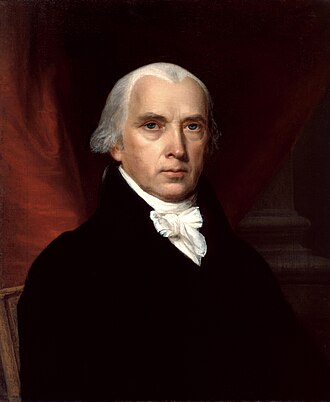
John Vanderlyn, 1816
Public domain
| Born | March 16, 1751 — Port Conway, Virginia |
| Died | June 28, 1836 — Montpelier, Virginia (age 85) |
| Presidency | 4th President, March 4, 1809 – March 4, 1817 |
| Party | Democratic-Republican |
| Spouse | Dolley Payne Todd (m. 1794) |
| Profession | Politician, political philosopher, planter |
Early Life and Family
James Madison was born on March 16, 1751 at Port Conway, Virginia, into a prosperous planter family. He was a sickly child and remained physically small throughout his life — at roughly 5 feet 4 inches and 100 pounds, he was the smallest president in American history. What he lacked in stature he more than compensated in intellect: he graduated from the College of New Jersey (now Princeton) in two years rather than four, then spent an additional year studying Hebrew and law.
His marriage to the vivacious widow Dolley Payne Todd in 1794 was transformative. Dolley became one of the most celebrated First Ladies in history — socially adept where James was reserved, and famous for rescuing Gilbert Stuart's portrait of Washington before fleeing the burning White House in 1814.
Before the Presidency
The Father of the Constitution
Madison arrived at the 1787 Constitutional Convention better prepared than anyone. His Virginia Plan — a framework for a bicameral legislature with proportional representation — became the structural foundation of the Constitution. He took meticulous notes throughout the convention (published decades after his death) that remain the primary historical record of the proceedings. He then co-authored the Federalist Papers with Alexander Hamilton and John Jay — 85 essays arguing for ratification that remain the most important commentary on the Constitution ever written.
Bill of Rights
Madison initially opposed a Bill of Rights as redundant — the Constitution already limited government power. But he changed his mind and personally shepherded the first ten amendments through Congress in 1789, largely to fulfil promises made to Anti-Federalists during ratification. Without Madison's advocacy, the Bill of Rights might never have happened.
The Presidency (1809–1817)
What He Built
- Led America through the War of 1812 — the first formally declared war in U.S. history — ultimately ending in a status quo peace that nonetheless boosted American national pride and identity.
- The war's end triggered the Era of Good Feelings under his successor Monroe — a period of national unity and one-party rule.
- His wartime experience converted the anti-bank, anti-standing-army Jefferson Republican into a pragmatist: he signed into law a new national bank and supported a stronger military after the war.
Controversies and Failures
- Washington burned (1814): British forces captured and burned Washington D.C., including the White House and Capitol. Madison and his Cabinet fled. It was the only time since the Revolution that a foreign power occupied the U.S. capital.
- Military unpreparedness: The U.S. entered the War of 1812 woefully unprepared — the army was small, underfunded, and poorly led. Early campaigns against Canada were disasters.
- Slavery: Madison enslaved over 100 people at Montpelier and, like Jefferson, never freed them. He was deeply uncomfortable with slavery but took no action against it.
Death
Madison outlived all the other Founders, dying on June 28, 1836 at his Montpelier estate at age 85. He reportedly refused to take stimulants that would have kept him alive until July 4 — he died quietly at breakfast. His last words were "Nothing more than a change of mind, my dear."
📜 Notable Quote
"If men were angels, no government would be necessary."
Federalist No. 51, 1788 — Madison's argument for why checks and balances are essential to any functioning republic.
Legacy and Writings
Madison's constitutional legacy is immense — the structure of American government bears his fingerprints more than any other single person. His convention notes, the Federalist Papers, and his extensive correspondence make him one of the most documented of the Founders. Montpelier is now a museum and constitutional education centre.
📊 How History Rates James Madison
- C-SPAN Historians Survey (2021): Ranked #20
- Siena College Research Institute (2022): Ranked #17
Madison is ranked lower than his constitutional stature might suggest — largely because his presidency coincided with a war the U.S. was unprepared for and partly lost. His pre-presidential intellectual contributions are considered among the greatest in American history.
How well do you know the Father of the Constitution?
Put your knowledge to the test.
Take the James Madison Quiz →