James Monroe: The Last Founding Father
The man who crossed the Delaware with Washington, defined American foreign policy for a century, and presided over the last era of national unity.
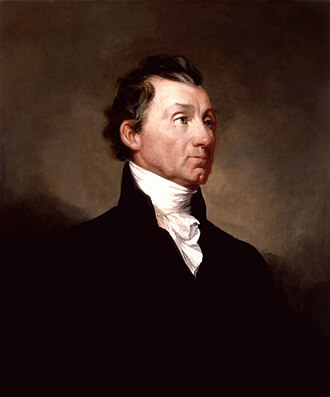
Samuel F. B. Morse, 1819
Public domain
| Born | April 28, 1758 — Westmoreland County, Virginia |
| Died | July 4, 1831 — New York City (age 73) |
| Presidency | 5th President, March 4, 1817 – March 4, 1825 |
| Party | Democratic-Republican |
| Spouse | Elizabeth Kortright (m. 1786) |
| Profession | Soldier, lawyer, diplomat, statesman |
Early Life and Family
James Monroe was born on April 28, 1758 in Westmoreland County, Virginia — the same county as George Washington. He was studying at the College of William & Mary when the Revolutionary War began, and he dropped out to enlist. At 18 he crossed the Delaware River with Washington on Christmas night 1776 and was seriously wounded at the Battle of Trenton, a musket ball lodging near his shoulder. He carried the wound for the rest of his life.
After the war he studied law under Thomas Jefferson, beginning a lifelong friendship. He married Elizabeth Kortright in 1786, and the couple had two daughters. Elizabeth was reserved and frequently ill, and spent little time in public life as First Lady.
Before the Presidency
Diplomat and Secretary of State
Monroe served as U.S. Minister to France during the turbulent 1790s — where he was so sympathetic to the French Revolution that Washington recalled him. Later, under Jefferson, he helped negotiate the Louisiana Purchase in Paris. As Madison's Secretary of State and simultaneously Secretary of War during the War of 1812, he was the most powerful figure in the Cabinet.
The Presidency (1817–1825)
What He Built
- Monroe Doctrine (1823): Declared the Western Hemisphere off-limits to future European colonisation or interference. It became the cornerstone of American foreign policy and remained operative for over a century — invoked as recently as the Cuban Missile Crisis.
- Florida Acquisition (1819): Negotiated the Adams-Onís Treaty, purchasing Florida from Spain and establishing the U.S. boundary with Spanish territories.
- Missouri Compromise (1820): Temporarily resolved the explosive question of slavery in new territories by admitting Missouri as a slave state and Maine as a free state, maintaining Senate balance.
- Era of Good Feelings: Monroe's presidency saw the collapse of the Federalist Party, leaving the Democratic-Republicans as the only national party. He won re-election in 1820 with just one electoral vote cast against him.
Controversies and Failures
- Missouri Compromise: Jefferson called it a "fire bell in the night" — a warning that the slavery question would eventually tear the nation apart. The compromise postponed the crisis for 40 years rather than solving it.
- Slavery: Monroe enslaved people throughout his life and, like his predecessors, did not free them. He supported the American Colonization Society — which proposed sending freed enslaved people to Africa — as an alternative to abolition.
Death
Monroe died on July 4, 1831 in New York City — making him the third of the first five presidents to die on Independence Day. He had been in declining health and financial difficulty for years, forced to sell his Virginia estate. He died at the home of his daughter in New York. He was 73.
📜 Notable Quote
"The best form of government is that which is most likely to prevent the greatest sum of evil."
Monroe's pragmatic philosophy of governance — shaped by decades of direct experience with revolution, war, and diplomacy.
Legacy and Writings
Monroe's greatest legacy is the doctrine that bears his name — though it was largely drafted by Secretary of State John Quincy Adams. The capital of Liberia, Monrovia, is named after him — founded as a home for freed American slaves. He was the last president to wear a powdered wig and tricorn hat, the last visible link to the Revolutionary generation.
📊 How History Rates James Monroe
- C-SPAN Historians Survey (2021): Ranked #13
- Siena College Research Institute (2022): Ranked #13
Monroe is consistently ranked in the top tier of "good but not great" presidents. The Monroe Doctrine alone earns him a permanent place in the top quarter of all rankings.
How well do you know the last Founding Father president?
Put your knowledge to the test.
Take the James Monroe Quiz →