Sofia: Capital of Bulgaria
One of Europe's oldest capitals, where Roman ruins sit beneath Orthodox churches, and a local bacterium changed the world's breakfast tables forever.
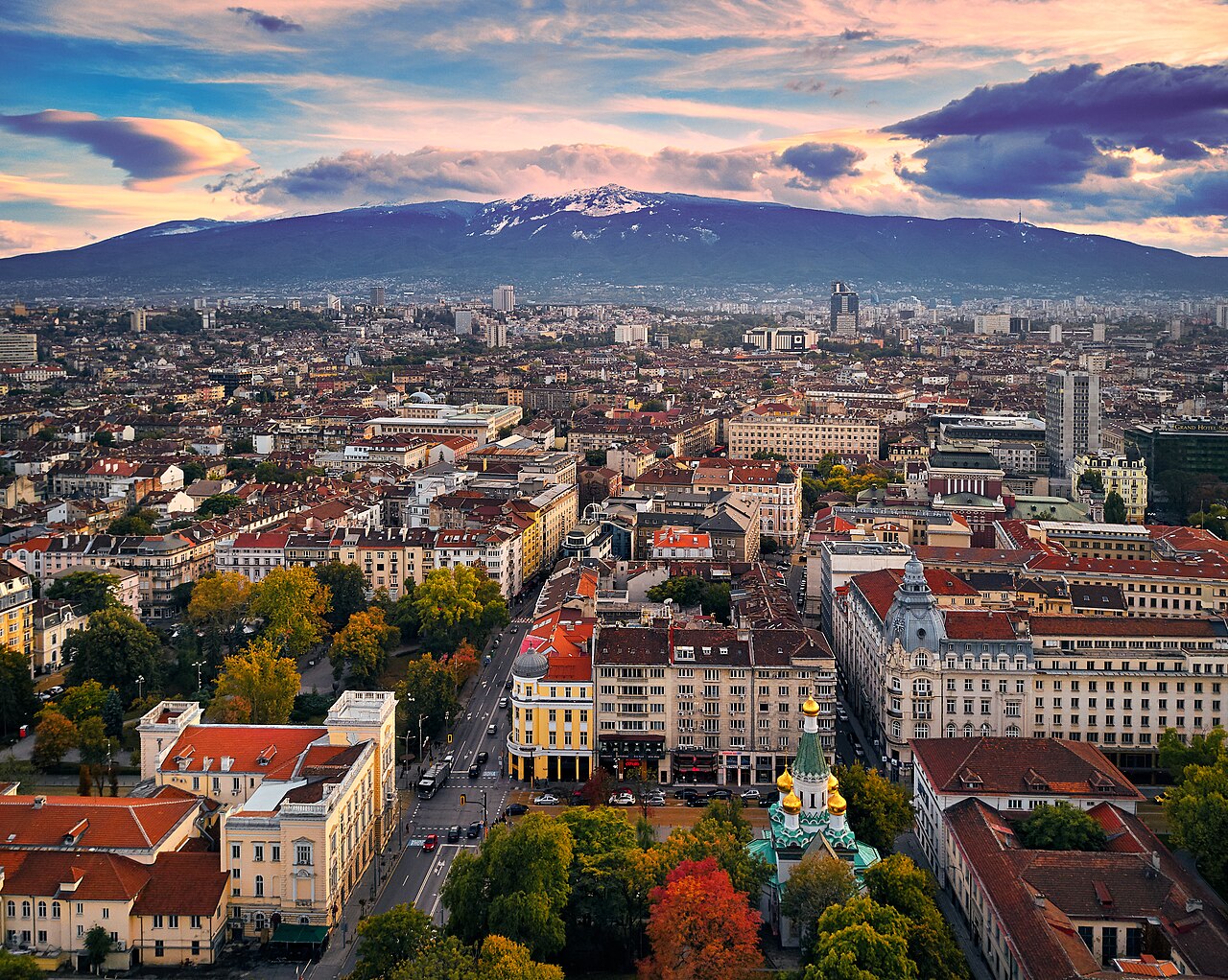
Alexander Nevsky Cathedral
Public domain (Wikimedia Commons)
| Population | 1.3 million (city) |
| Ancient name | Serdica (Roman, founded ~100 AD) |
| Settlement age | 7,000+ years of habitation |
| Ottoman rule | 1382–1878 (nearly 500 years) |
| Cathedral | Alexander Nevsky, built 1912 |
| EU membership | 2007 |
History
Serdica: Rome's Favourite City
The area around Sofia has been inhabited for over 7,000 years, but it was the Romans who truly built it. Emperor Trajan elevated Serdica to a major administrative centre around 100 AD, and it became one of the most important cities in the Roman Empire. Emperor Constantine the Great — who later founded Constantinople — so loved Serdica that he reportedly said: "Serdica is my Rome." The remains of Serdica's Roman streets, towers, and amphitheatre can still be seen beneath the modern city, particularly under the Presidency building and the metro stations.
Bulgarian Kingdoms and Ottoman Conquest
Bulgaria established the First Bulgarian Empire in 681 AD — one of the earliest and most important medieval Slavic states. Crucially, Bulgaria became the first Slavic country to adopt the Cyrillic alphabet, created by Saints Cyril and Methodius and their disciples in the 9th century. The Bulgarian Orthodox Church and Slavic literary tradition radiated from here across Eastern Europe. In 1382, the Ottoman Empire captured Sofia and held it for nearly five centuries. During this period, the city grew as an Ottoman administrative hub, with mosques, bazaars, and baths overlaid on the Byzantine and Roman foundations.
Liberation and the Modern Capital
Bulgaria was liberated from Ottoman rule in the Russo-Turkish War of 1877–78, when Russian forces — aided by Bulgarian volunteers — defeated the Ottomans at the Battle of Shipka Pass and elsewhere. The monumental Alexander Nevsky Cathedral, completed in 1912, was built as a memorial to the 200,000 Russian soldiers who died liberating Bulgaria. Its golden dome dominates Sofia's skyline and its interior contains some of the finest Orthodox iconography in the Balkans. After liberation, Sofia was chosen as the Bulgarian capital in 1879.
Landmarks & Culture
Alexander Nevsky Cathedral
The Alexander Nevsky Cathedral is one of the largest Eastern Orthodox cathedrals in the world, seating 5,000 worshippers. Named after the Russian medieval prince and saint, it was funded by public donations and built between 1882 and 1912. The crypt contains an extraordinary collection of Bulgarian medieval icons. The cathedral square outside is a popular antique and book market on weekends and serves as Sofia's unofficial civic heart.
Under the City: Roman Serdica
Sofia's Serdica metro station is unique in Europe: while building the metro in the 2000s, workers uncovered an entire Roman street grid. Rather than destroy it, the city built a glass-floored archaeological museum directly into the station, so commuters walk above ancient Roman roads and mosaic floors. The adjacent Rotunda of St George — a Roman circular temple converted to a Christian church — dates to the 4th century and still stands in perfect condition, surrounded by modern buildings.
Fast Facts
- Sofia is one of the oldest capitals in Europe, with continuous settlement dating back to 7000 BCE — arguably older than Athens as an urban centre
- Lactobacillus bulgaricus — the bacterium that makes yogurt — was named after Bulgaria, where it was first isolated in 1905 by Stamen Grigorov
- Bulgaria was the first Slavic state to adopt Cyrillic, making Sofia the spiritual origin of the alphabet used today by Russians, Ukrainians, Serbs, and Mongolians
- The Boyana Church near Sofia contains 13th-century frescoes considered among the finest examples of medieval European painting — a UNESCO World Heritage Site
- Sofia sits at 550 metres altitude at the foot of Vitosha Mountain — one of the few capitals with a national park visible from the city centre
📊 Bulgaria in Numbers
- Population: ~6.5 million (and declining — one of the fastest-depopulating countries in Europe)
- Area: 110,879 km²
- Bulgaria is the 2nd largest country in the Balkans after Serbia
- Alexander Nevsky Cathedral has a dome height of 45 metres and a bell tower of 53 metres
- Bulgaria joined NATO in 2004 and the EU in 2007