Ljubljana: Capital of Slovenia
Europe's smallest capital is guarded by a dragon and reshaped by a visionary architect. Ljubljana punches far above its size in livability, cycling culture, and Central European charm.
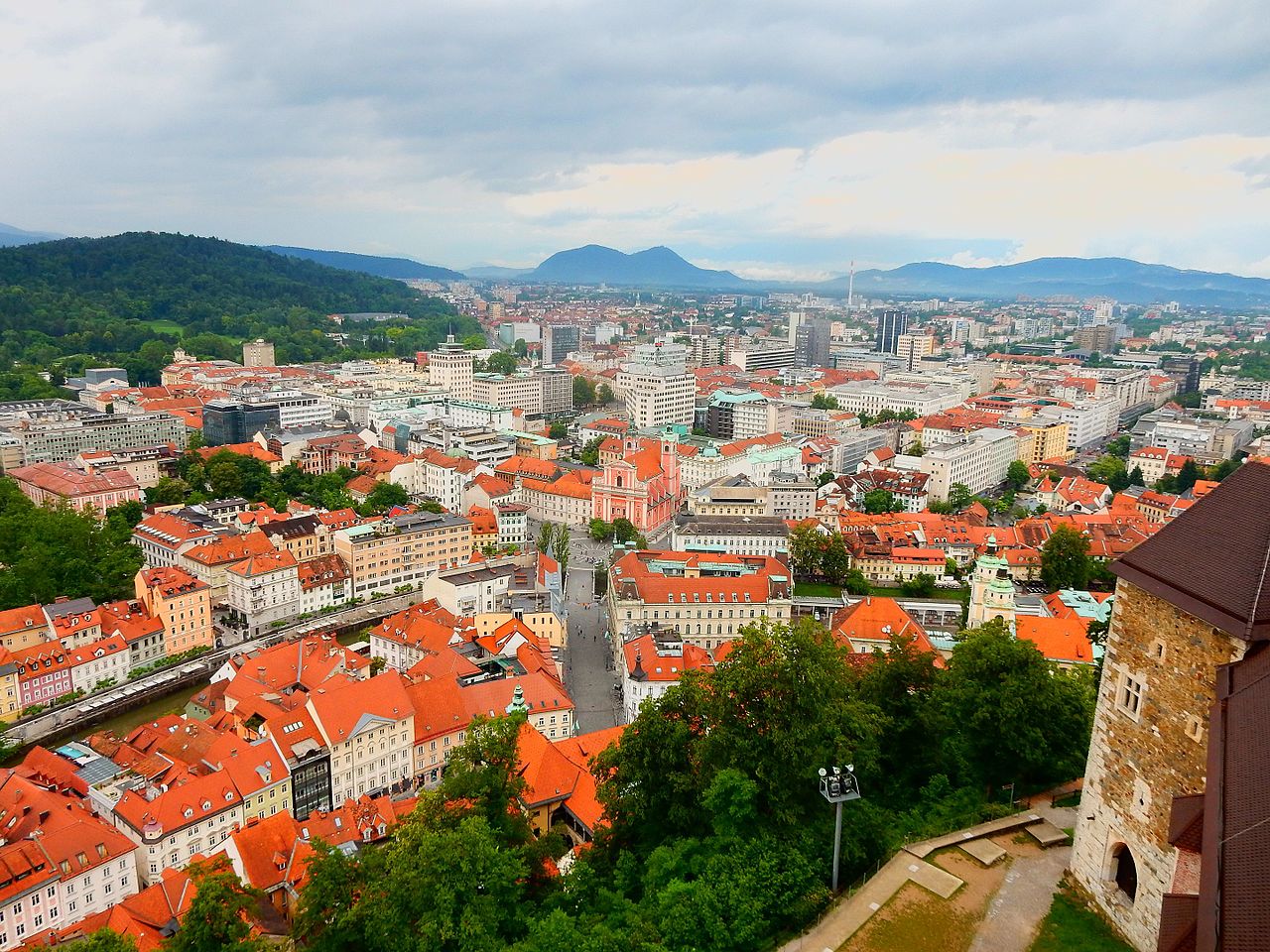
Ljubljana Castle and old town
Public domain (Wikimedia Commons)
| Population | ~300,000 (city) — smallest EU capital |
| Symbol | The Ljubljana Dragon (zmaj) |
| Independence | 1991 (Ten-Day War) |
| Key architect | Jože Plečnik (1920s–50s redesign) |
| Famous bridge | Tromostovje (Triple Bridge) |
| EU membership | 2004 |
History
The Dragon Legend and Roman Emona
Ljubljana's founding myth involves the hero Jason of Argonauts fame — who supposedly slew a dragon in the marshes here on his return from Colchis. This dragon, the zmaj, became the city's symbol and appears on Ljubljana's coat of arms, the castle tower, and the famous Dragon Bridge (1901). The Romans established Emona here around 14 AD as a legionary camp; excavations in the city reveal Roman street grids, villas, and an early Christian basilica. The settlement grew through medieval rule by the Habsburgs, who held Ljubljana — then called Laibach — for over five centuries.
Plečnik's City: An Architect's Masterpiece
What makes Ljubljana truly unique in Europe is the transformation carried out by architect Jože Plečnik (1872–1957). A student of Otto Wagner in Vienna, Plečnik returned to Ljubljana in 1921 and spent the next three decades reshaping it according to a singular vision that blended ancient classical forms with art nouveau and early modernism. He designed the Triple Bridge (Tromostovje), the covered market along the Ljubljanica, the National and University Library, the cemetery at Žale, and dozens of fountains, lamp posts, and public spaces. The result is a city with extraordinary visual coherence — almost no two lamp posts are alike, yet the whole feels unified. UNESCO recognised Plečnik's work in Ljubljana as a World Heritage Site in 2021.
Slovenian Independence: The Ten-Day War
When Slovenia declared independence from Yugoslavia on June 25, 1991, the Yugoslav People's Army (JNA) moved against it. What followed was the Ten-Day War — a remarkably short conflict in which Slovenian territorial defence forces outmanoeuvred the JNA using clever logistics, international media pressure, and a well-prepared civilian support network. Casualties were minimal on both sides. The Brioni Agreement on July 7, 1991 ended hostilities, and by October Slovenia was internationally recognised. Unlike Croatia, Bosnia, and Kosovo, Slovenia achieved independence with minimal bloodshed — a fact that shaped its rapid integration into NATO and the EU.
Landmarks & Culture
Ljubljana Castle and the Old Town
Ljubljana Castle sits on a 375-metre hill directly above the medieval old town and can be reached by funicular from the central market. The hilltop fortress offers panoramic views of the Julian Alps to the northwest — including Triglav, Slovenia's highest peak and national symbol. Below the castle, the Ljubljanica River curves through the old town, lined with café terraces and Plečnik's covered market. The Metelkova district — a former Yugoslav army barracks occupied by artists after independence — is now a vibrant alternative cultural quarter with galleries, clubs, and hostels.
Fast Facts
- Ljubljana is the smallest capital city in the EU by population, with around 300,000 people
- The city has been ranked one of Europe's most liveable and greenest capitals multiple times, with a car-free old town
- Slovenia adopted the euro in 2007 — one of the first former Yugoslav states to do so
- The Škocjan Caves (UNESCO) and Lake Bled are within an hour of Ljubljana — making it a gateway to spectacular natural scenery
- Plečnik's Triple Bridge was originally a single bridge (1842) to which Plečnik added two pedestrian bridges in 1932, creating the iconic triple structure
📊 Slovenia in Numbers
- Population: ~2.1 million — one of the smallest EU member states
- Area: 20,271 km² — slightly smaller than Wales
- Slovenia borders 4 countries: Italy, Austria, Hungary, and Croatia
- GDP per capita: one of the highest in Eastern Europe, comparable to Portugal and Greece
- Over 60% of Slovenia is covered by forest — one of Europe's most forested countries
How well do you know the City of the Dragon?
Put your knowledge to the test.
Take the Ljubljana Quiz →