London: Capital of the United Kingdom
Roman Londinium, Viking raids, the Great Fire, the Blitz — and still standing. Once the capital of a quarter of the world. How well do you know London?
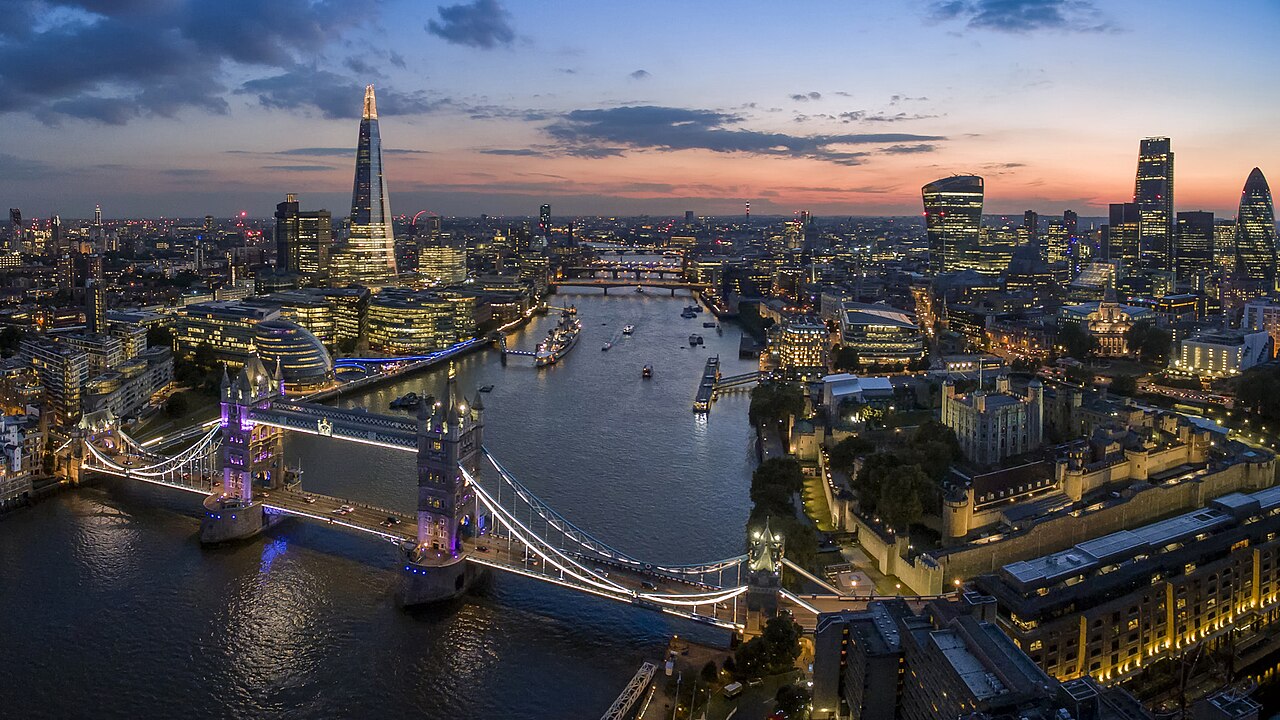
Tower Bridge over the Thames
Public domain (Wikimedia Commons)
| Population | 9 million (city); 14 million (metro) |
| Founded | c. 43 AD as Roman Londinium |
| Language | English |
| Time zone | UTC / GMT (Greenwich Mean Time) |
| Underground | World's first (1863) |
History
Roman to Medieval
The Romans founded Londinium around 43 AD at a strategic Thames crossing, building a bridge, a forum, and a basilica. After Roman withdrawal in the 5th century, the city was resettled — first by Saxons, then raided by Vikings. The Norman conquest of 1066 brought William the Conqueror, who built the Tower of London to dominate the city. By the 13th century London was England's dominant commercial centre; by the 15th it was one of northern Europe's great cities.
Fire, Empire, and Blitz
The Great Fire of 1666 destroyed 13,200 houses and 87 churches in three days. Christopher Wren was given the task of rebuilding — he designed the new St Paul's Cathedral (completed 1710) and 51 other churches. As Britain built its global empire in the 18th and 19th centuries, London became the world's largest city and busiest port. The Blitz of 1940–41 — German bombing raids over 57 consecutive nights — killed over 43,000 Londoners and destroyed vast swaths of the East End, but did not break the city.
Landmarks
Tower of London & Tower Bridge
The Tower of London, begun by William the Conqueror in 1066, has served as a royal palace, prison, treasury, and execution site. Anne Boleyn, Thomas More, and Lady Jane Grey were executed here. Today it houses the Crown Jewels. Immediately adjacent is Tower Bridge (completed 1894) — the Victorian Gothic bascule bridge most tourists mistakenly call "London Bridge" (London Bridge is the unassuming bridge nearby).
The British Museum
Founded in 1753, the British Museum was the world's first public national museum — open to all "studious and curious persons." Its collection of 8 million objects spans 2 million years of human history: the Rosetta Stone, the Elgin Marbles (claimed by Greece), the Lewis Chessmen, the Sutton Hoo helmet. It receives over 6 million visitors a year.
The Underground
The London Underground — "the Tube" — opened on January 10, 1863, making it the world's first metro system. The original section ran steam locomotives between Paddington and Farringdon. Today the network has 272 stations and 402 km of track, carrying 1.3 billion passengers a year. Harry Beck's 1931 tube map — a schematic diagram that distorted geography for clarity — revolutionised transit cartography worldwide.
Fast Facts
- London's Greenwich is the reference point for Coordinated Universal Time (UTC)
- Big Ben is technically the name of the bell inside the Elizabeth Tower — not the tower itself
- London has over 8 million trees — technically qualifying as an urban forest
- The city has 170 museums, most of which are free to enter
- The Thames has over 200 bridges from its source to the sea