Madrid: Capital of Spain
Europe's highest capital, home to the Prado and the Bernabéu. Madrid became Spain's capital only in 1561 — yet it holds one of the world's great art collections and football clubs.
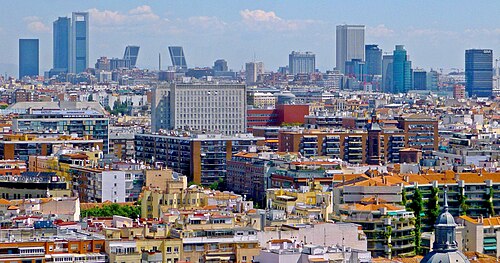
Royal Palace of Madrid
Public domain (Wikimedia Commons)
| Population | 3.3 million (city); 6.7 million (metro) |
| Founded | 9th century as Moorish fortress Magerit |
| Language | Spanish (Castilian) |
| Capital since | 1561 under Philip II |
| Altitude | 667 m — highest EU capital |
History
From Magerit to Imperial Capital
Unlike most European capitals, Madrid has no ancient Roman or Greek origins. It began as a minor Moorish fortress — Magerit — in the 9th century, built to protect Toledo from Christian advance. After the Reconquista, it remained a small town until 1561, when Philip II moved Spain's royal court there from Toledo. Its central location on the Iberian Peninsula made it the ideal administrative hub for the vast Spanish Empire spanning the Americas, Europe, and Asia.
The Spanish Civil War
Madrid was one of the most contested battlegrounds of the Spanish Civil War (1936–39). Republican forces held the city under siege for nearly three years against Franco's Nationalist army — the battle cry "No pasarán" (They shall not pass) was born here. The city endured aerial bombardment, street fighting, and near-starvation. When Madrid finally fell in March 1939, the war effectively ended. Francisco Franco ruled Spain as dictator until his death in 1975; democracy was restored through the Transición.
Landmarks & Art
The Prado
The Museo del Prado, opened in 1819, is one of the world's greatest art museums — and unlike the Louvre or the British Museum, it focuses almost exclusively on painting. Its collection of Velázquez (including Las Meninas), Goya (the Black Paintings, The Third of May), El Greco, Titian, and Rubens is unmatched anywhere on earth.
The Golden Triangle of Art
The Prado anchors what Madrileños call the Golden Triangle of Art: three world-class museums within walking distance. The Reina Sofía holds modern and contemporary Spanish art — including Picasso's Guernica, his searing response to the Nazi bombing of a Basque town during the Civil War. The Thyssen-Bornemisza fills the gaps with Old Masters, Impressionists, and American art.
Plaza Mayor and the Old Centre
Plaza Mayor, completed in 1619 under Philip III, is one of Europe's finest Baroque squares — 129 × 94 metres of uniform arcaded façades. It has hosted royal celebrations, bullfights, markets, and Inquisition executions. Puerta del Sol, a short walk away, is the symbolic centre of Spain — the "Kilometre Zero" from which all national road distances are measured, and the site of the famous New Year's Eve grape-eating tradition.
Fast Facts
- Madrid is the highest capital city in the EU at 667 metres above sea level
- The Retiro Park (350 hectares) was a royal retreat for 200 years before opening to the public in 1868
- Real Madrid has won the UEFA Champions League / European Cup a record 15 times
- The city receives over 300 days of sunshine per year
- Madrid's metro system is the second largest in Europe by length (294 km)