Lisbon: Capital of Portugal
Built on seven hills above the Tagus, Lisbon launched the Age of Discovery. Vasco da Gama sailed from here to India. The 1755 earthquake rebuilt the city. Europe's westernmost capital.
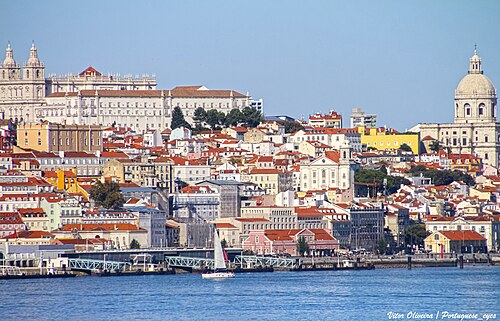
View over Alfama, Lisbon
Public domain (Wikimedia Commons)
| Population | 550,000 (city); 2.9 million (metro) |
| Founded | Over 3,000 years of habitation |
| Language | Portuguese |
| Location | Westernmost EU capital (9°W) |
| River | Tagus (Tejo) |
| Hills | Seven (like Rome) |
History
From Phoenicians to Portuguese Kingdom
Lisbon has been a port since Phoenician traders established a settlement around 1200 BC. The Romans called it Olisipo. After Rome's fall, Visigoths and then Moors controlled it — the Moorish period (714–1147) left its most visible legacy in the narrow, labyrinthine streets of the Alfama district, which survived the 1755 earthquake largely intact. In 1147, the first King of Portugal, Afonso Henriques, captured Lisbon with the help of Crusaders — an episode commemorated in the castle of São Jorge overlooking the city.
The Age of Discovery
In the 15th and 16th centuries, Lisbon became the launchpad for the most ambitious programme of maritime exploration in history. From the Tower of Belém and the nearby docks, Portuguese navigators sailed to Africa, India, Brazil, and Japan. Bartolomeu Dias rounded the Cape of Good Hope in 1488; Vasco da Gama reached India by sea in 1498; Pedro Álvares Cabral reached Brazil in 1500. The wealth that flowed back — spices, gold, slaves — made Lisbon one of the richest cities in the world. The uniquely Portuguese Manueline architectural style, blending Gothic and maritime motifs, was the artistic expression of this era.
The 1755 Earthquake
On All Saints' Day, November 1, 1755, one of the deadliest earthquakes in European history struck Lisbon. The initial quake — estimated at magnitude 8.5–9 — was followed by fires and a tsunami. Between 30,000 and 60,000 people died; most of medieval Lisbon was destroyed. The Marquis of Pombal, Portugal's chief minister, responded with extraordinary organisational energy — famously ordering: "Bury the dead and feed the living." He rebuilt the lower city (the Baixa) as a planned grid of Enlightenment rationalism, with earthquake-proof construction techniques tested on scale models.
Landmarks
Jerónimos Monastery
Built from 1501 in the Manueline style, the Mosteiro dos Jerónimos in Belém is one of Portugal's most spectacular monuments and a UNESCO World Heritage Site. It was commissioned by King Manuel I from the profits of the spice trade. Vasco da Gama and the poet Luís de Camões are buried here.
Alfama and Fado
The Alfama district — Lisbon's oldest surviving neighbourhood, winding up to the Castelo de São Jorge — is the birthplace of fado, Portugal's melancholic musical tradition. Fado (from Latin fatum — fate) expresses the concept of saudade: a longing for something lost or absent. UNESCO added fado to its Intangible Cultural Heritage list in 2011.
Fast Facts
- Lisbon's famous yellow trams (especially Tram 28) climb the city's hills and have operated since 1873
- The Vasco da Gama Bridge across the Tagus (17.2 km) is the longest bridge in Europe
- Lisbon is at 38°N latitude — further south than many people expect for a European capital
- Pastéis de Belém — custard tarts made to a secret recipe since 1837 in a bakery next to the Jerónimos Monastery — are the city's most famous food export
How well do you know Europe's westernmost capital?
Put your knowledge to the test.
Take the Lisbon Quiz →