Dublin: Capital of Ireland
A Viking black pool that became the birthplace of four Nobel literature laureates, the 1916 Rising, and the world's most generous beer lease — 9,000 years at £45 per year.
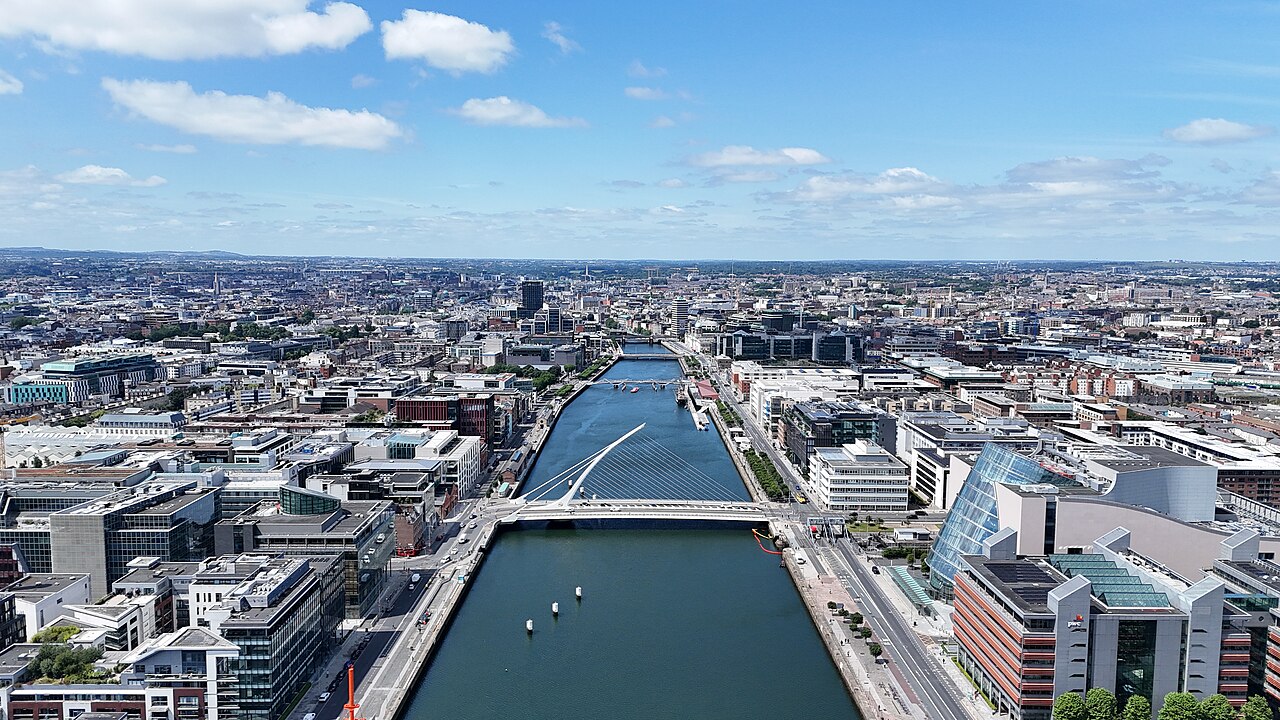
Ha'penny Bridge over the River Liffey
Public domain (Wikimedia Commons)
| Population | 1.4 million (city); 2 million (metro) |
| Founded | 841 AD as a Viking longphort |
| Languages | English + Irish (Gaeilge), both official |
| Independence | 1922, Republic declared 1949 |
| Nobel Literature | 4 winners (Yeats, Shaw, Beckett, Heaney) |
History
The Black Pool
Dublin's name comes from the Irish Dubh Linn — "black pool" — referring to a dark tidal pool where the River Poddle met the Liffey. Norse Vikings established a longphort (ship camp) here in 841 AD and later built a permanent settlement. The Gaelic name Baile Átha Cliath ("town of the hurdled ford") refers to an earlier crossing point and remains the city's official Irish name today. The Vikings were eventually defeated at the Battle of Clontarf (1014) by High King Brian Boru — though Brian himself was killed in his tent after the battle by a fleeing Viking warrior.
British Rule and the 1916 Rising
Ireland fell under English control progressively from the 12th century onwards, with Dublin as the seat of British administration in Ireland. On Easter Monday, April 24, 1916, a group of Irish republican rebels seized key buildings across Dublin and declared an Irish Republic. The General Post Office (GPO) on O'Connell Street served as headquarters. The Rising was crushed within six days; its leaders were executed by firing squad, transforming them into martyrs. The public outrage this caused shifted Irish opinion decisively toward independence — achieved in 1922 after the Anglo-Irish War.
Literature and the Diaspora
Despite — or because of — centuries of hardship, Ireland produced a disproportionate share of English-language literary giants. Dublin claims four Nobel Prize winners in Literature: W.B. Yeats (1923), George Bernard Shaw (1925), Samuel Beckett (1969), and Seamus Heaney (1995). James Joyce, though never honoured with the Nobel, set his masterwork Ulysses entirely in Dublin on a single day — June 16, 1904 — now celebrated annually as Bloomsday. The Great Famine (1845–1852) drove over a million people to emigrate; today approximately 40 million Americans claim Irish ancestry.
Landmarks & Culture
Trinity College and the Book of Kells
Trinity College Dublin, founded in 1592, is Ireland's oldest university and home to the Book of Kells — an illuminated manuscript Gospel book created by Irish monks around 800 AD. Regarded as one of the finest examples of Insular art in the world, it is displayed in Trinity's Long Room library, a barrel-vaulted hall lined with 200,000 of the oldest books in Ireland. The Book of Kells draws over 500,000 visitors per year.
The Guinness Lease
In 1759, Arthur Guinness signed a 9,000-year lease on St James's Gate Brewery for £45 per year. The lease, which technically runs until the year 10,759, is displayed at the Guinness Storehouse — now the most visited tourist attraction in Ireland. The brewery covers 26 hectares in central Dublin and produces approximately 2.5 million pints of Guinness every day.
Fast Facts
- Dublin's Ha'penny Bridge (1816) got its name from the half-penny toll originally charged to cross it; the toll was abolished in 1919
- Ireland has the youngest population in the EU, with a median age of around 38
- The Irish Pub is a legally protected cultural export — the government has guidelines for what makes a genuine Irish pub
- Dublin Bay was so strategically important that during WWII, neutral Ireland quietly allowed Allied aircraft to fly over Donegal — the so-called Donegal Corridor
- Four Nobel Prizes in Literature — more per capita than almost any other city on earth
📊 Ireland in Numbers
- 9,000 years — Arthur Guinness's lease on St James's Gate Brewery (signed 1759, expires 10,759)
- 40 million — Americans who claim Irish ancestry (Ireland's population is 5 million)
- 4 Nobel Prizes in Literature for a nation of 5 million people
- 2.5 million pints of Guinness brewed in Dublin every single day
How well do you know the city of Joyce and Guinness?
Put your knowledge to the test.
Take the Dublin Quiz →