Brussels: Capital of Belgium
Home to the EU and NATO, a Grand Place rebuilt after French bombardment, and the world's most absurd political record — 541 days without a government.
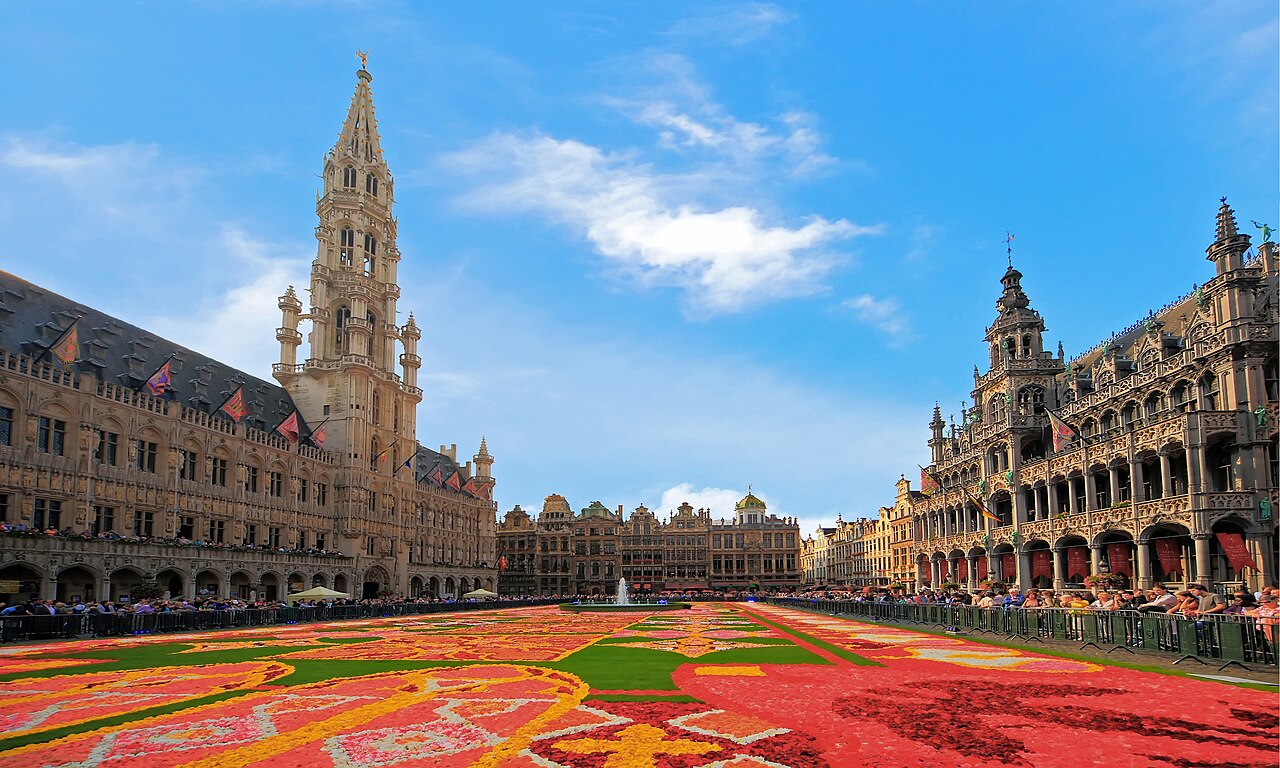
The Grand Place, heart of Brussels
Public domain (Wikimedia Commons)
| Population | 1.2 million (city); 2.1 million (metro) |
| Founded | 979 AD, official city charter 1229 |
| Languages | French, Dutch (Flemish), German (all official) |
| Government levels | 11 — federal, regional, community, municipal |
| EU/NATO HQ | Yes — both headquartered in Brussels |
History
From Marshland to European Capital
Brussels began as Bruocsella — a settlement on a marshy island in the Senne river — around 979 AD, when Charles of France, Duke of Lower Lorraine, built a fortress there. The city grew into a major trading hub under the Dukes of Burgundy in the 14th and 15th centuries. Its central market square, the Grand Place, became one of the finest Gothic commercial squares in Europe. Then, on August 13–15, 1695, French forces under Marshal de Villeroy bombarded the city with over 3,000 cannonballs and incendiary devices, destroying nearly everything. What stands today — rebuilt in just four years by the guilds — is the 1695 reconstruction, which Victor Hugo called "the most beautiful square in the world."
Belgium's Impossible Politics
Belgium became independent in 1830, splitting from the Netherlands after a revolution triggered by an opera performance. The country is famously divided between Dutch-speaking Flanders and French-speaking Wallonia — a division that makes forming a national government an act of political acrobatics. Between June 2010 and December 2011, Belgium went 541 days without a government, setting a world record for a functioning democracy. The country continued to operate, pay its bills, and host its EU institutions — apparently suggesting that governments are at least partially optional.
Brussels as the Capital of Europe
After World War II, Brussels became the de facto headquarters of the emerging European project. The Treaty of Brussels (1948) helped lay the groundwork for NATO, which was formally established in 1949. The European Economic Community (later the EU) chose Brussels as its administrative base in 1958 — the same year the city hosted the World Expo and unveiled the Atomium, a 102-metre iron crystal structure enlarged 165 billion times, which has become the city's most distinctive landmark.
Landmarks & Culture
The Grand Place
The Grand Place (Grote Markt) is Brussels's central square and a UNESCO World Heritage Site since 1998. The Gothic Town Hall (1402–1455) survived the 1695 bombardment; everything around it was rebuilt by the city's merchant guilds, each contributing an ornate guildhall. Today the square hosts flower markets, the Tapis de Fleurs (biennial carpet of 700,000 begonias), and the Belgian Beer Weekend. The square is surrounded by 36 baroque buildings, each named after the guild that built it: the Brewers' House, the Bakers' House, the Haberdashers' House.
Manneken Pis
Brussels's most famous — and most surprising — landmark is a bronze statue just 60 centimetres tall. Manneken Pis ("Little Man Pee") depicts a small boy urinating into a fountain. First cast in bronze in 1619 by sculptor Jérôme Duquesnoy, the statue has become a symbol of Brussels's self-deprecating humour. He has an official wardrobe of over 1,000 costumes, donated by governments, organisations, and individuals worldwide — including an Elvis outfit, a samurai, and a Manneken Pis Santa.
Fast Facts
- Belgium produces over 220,000 tonnes of chocolate per year; Brussels airport is the world's largest single point of chocolate sales
- French fries were invented in Belgium (not France) — Belgians have been frying potatoes since at least 1680, and "frites" culture is serious business
- The city has 11 levels of government — federal, 3 regional, 3 community, and local — for a country of 11 million people
- The Atomium represents an iron crystal magnified 165 billion times; its nine spheres each measure 18 metres in diameter
- Brussels is home to roughly 1,000 international organisations and 40,000 EU officials — making it arguably the most politically important city per capita in the world
📊 Belgium in Numbers
- 541 days — world record for a democracy operating without a government (2010–2011)
- 11 governments — the number of executive bodies governing Belgium simultaneously
- 1,500+ types of Belgian beer officially recognised; Belgium has more beer varieties per capita than any country
- 60 cm — the surprisingly modest height of Brussels's most famous resident, Manneken Pis