Bern: Federal City of Switzerland
Technically not Switzerland's capital — but the city where Einstein published his theory of relativity, where bears have lived since medieval times, and where six kilometres of covered arcades shelter Europe's longest continuous shopping street.
The Old City of Bern above the Aare
Public domain (Wikimedia Commons)

| Population | 134,000 (city); 430,000 (metro) |
| Founded | 1191 by Duke Berthold V of Zähringen |
| Status | Bundesstadt (Federal City) — not official capital |
| Languages | German (local dialect: Bernese German) |
| UNESCO | Old City is a World Heritage Site since 1983 |
History
Not Quite a Capital
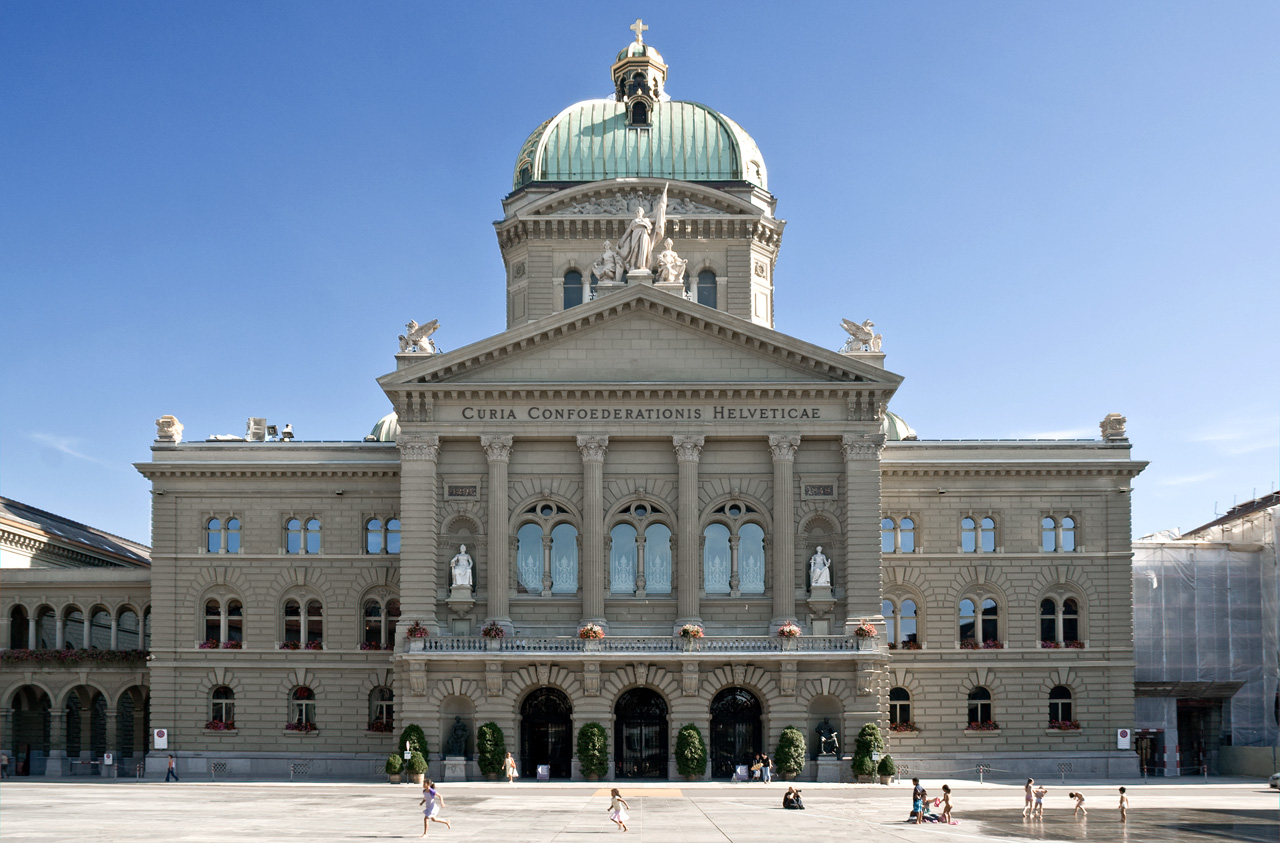
Here is a fact that surprises most people: Switzerland has no official capital. The Swiss Federal Constitution designates Bern only as the Bundesstadt — the "Federal City" — where the parliament and federal government sit. This reflects Switzerland's deeply federal structure: no single city was allowed to claim capital status lest it overshadow the cantons. The arrangement dates to 1848, when the modern Swiss Confederation was founded and Bern was chosen as the seat of government largely for its central geographic position and political neutrality between French- and German-speaking Switzerland.
Founded on a Bear (Maybe)
According to legend, Duke Berthold V of Zähringen founded the city in 1191 and named it after the first animal killed in a hunt on that site — a bear (Bär in German). Whether or not the story is true, bears became inseparably linked to Bern's identity. The city has kept live bears since at least the 16th century; the Bärengraben (Bear Pits) have housed bears continuously for centuries, and bears appear on the city's coat of arms, flag, and fountains throughout the Old City.
Einstein's Miracle Year
Between 1902 and 1909, Albert Einstein worked as a patent clerk at the Federal Patent Office in Bern while quietly transforming physics. In 1905 — his Annus Mirabilis ("Miracle Year") — Einstein published four groundbreaking papers from Bern: the photoelectric effect (for which he won the Nobel Prize), Brownian motion, special relativity (E = mc²), and the mass-energy equivalence paper. He wrote them while employed full-time and raising a family. His apartment at Kramgasse 49 is now the Einstein Haus museum, one of the most quietly remarkable addresses in the history of science.
Landmarks & Culture
The Lauben — Six Kilometres of Arcades
Bern's Old City is defined by its Lauben — covered arcades running along the ground floors of buildings throughout the medieval centre. With approximately 6 kilometres of continuous arcades, it forms one of the longest covered pedestrian promenades in the world. Built from the 13th century onward, the arcades protected merchants and shoppers from rain and snow — and today shelter a seamless sequence of boutiques, restaurants, and bakeries. The entire Old City was designated a UNESCO World Heritage Site in 1983.
The Universal Postal Union
Bern is home to the Universal Postal Union (UPU), founded in 1874 — one of the world's oldest international organisations and a United Nations specialised agency. The UPU standardised international mail rules, ensuring that a letter posted anywhere in the world can reach any other country. Before the UPU, international postage required a different stamp for each country a letter transited through. Bern's tradition as a neutral, central hub made it the natural home for early international organisations.
Fast Facts
- Bern's Old City sits on a peninsula formed by a meander of the Aare river — the river loops almost 360° around the medieval centre
- The city's Zytglogge (Clock Tower), built around 1218, has an astronomical clock added in 1530 that still performs an automated show four minutes before each hour
- Switzerland has four official languages: German, French, Italian, and Romansh
- Despite being a small city, Bern hosts the Zentrum Paul Klee — one of the most architecturally striking art museums in Europe, dedicated to the Swiss-German painter
- Einstein wrote his special relativity paper while commuting on the tram — reportedly staring at the clock tower and wondering what would happen if the tram moved at the speed of light
📊 Switzerland in Numbers
- 4 national languages — German (63%), French (23%), Italian (8%), Romansh (0.5%)
- 1905 — the year Einstein published 4 papers that changed physics, all while working a day job in Bern
- 6 km of covered arcades in Bern's Old City — among the longest in the world
- 1848 — the year Bern became the Federal City, without ever being officially called a capital