Budapest: Capital of Hungary
Two cities — Buda and Pest — united in 1873 across the Danube. The "Paris of the East" gave the world the Rubik's Cube, the ballpoint pen, and Europe's most spectacular thermal baths.
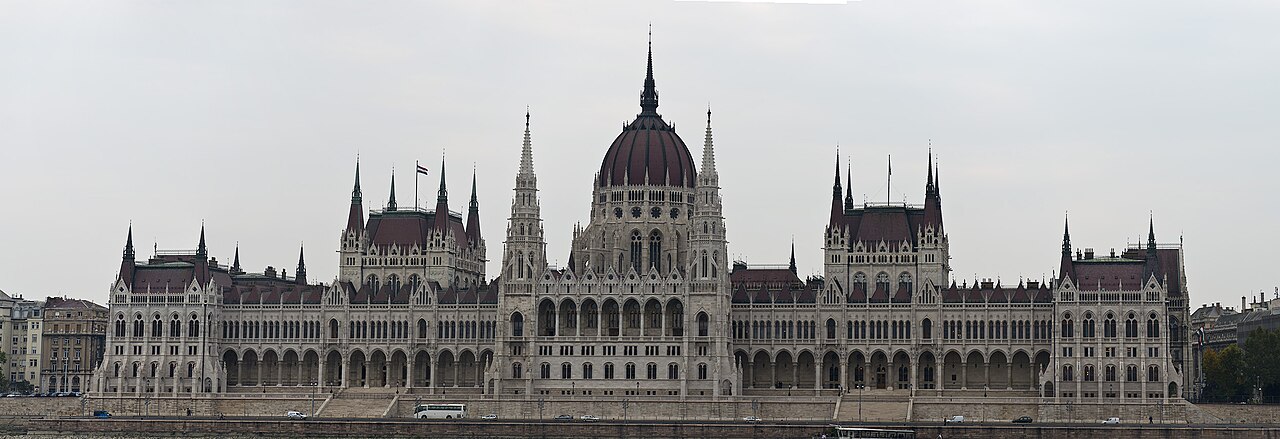
Budapest from the Citadella
Public domain (Wikimedia Commons)

| Population | 1.75 million (city); 3.3 million (metro) |
| Founded | 1873 — merger of Buda, Pest and Óbuda |
| Language | Hungarian (Magyar) |
| River | Danube (divides Buda from Pest) |
| Thermal springs | 120 beneath the city |
| Nickname | Paris of the East |
History
Roman, Magyar, Ottoman, Habsburg
The site of Budapest has been strategically important for millennia — the Romans built the fortress of Aquincum here. The Magyar tribes settled the Carpathian Basin around 895 AD under Árpád, establishing the Kingdom of Hungary. After the disastrous Battle of Mohács (1526), much of Hungary fell under Ottoman rule for 150 years; Buda was an Ottoman city with mosques and bathhouses. The Habsburgs expelled the Ottomans in 1686 and rebuilt the city in the Baroque style. Budapest was created in 1873 when the three towns of Buda, Pest, and Óbuda were formally unified — just as Hungary was gaining substantial autonomy within the Austro-Hungarian Dual Monarchy.
The 1956 Revolution
On October 23, 1956, a student demonstration in Budapest sparked the Hungarian Revolution — the most serious challenge to Soviet authority in the Eastern Bloc. Within days, Hungarian forces joined the uprising; the Soviet army withdrew briefly. Then, on November 4, Soviet tanks re-entered Budapest in force. Street fighting lasted two weeks; approximately 2,500 Hungarians and 700 Soviet soldiers died. Over 200,000 Hungarians fled as refugees — one of the largest refugee movements in Cold War Europe. The revolution was crushed; its leader Imre Nagy was executed in 1958.
Landmarks
Buda Castle and the Castle District
Buda Castle (Royal Palace) crowns Castle Hill on the western bank — a UNESCO World Heritage Site along with the entire Castle District, Andrássy Avenue, and the Millennium Underground Railway (1896, the first metro on the European continent). The castle has been destroyed and rebuilt multiple times; the current building dates largely from the 18th–19th century.
Parliament and Chain Bridge
The Hungarian Parliament Building on the Pest bank (1902) — Neo-Gothic, 268 metres long, 96 metres tall — is one of the largest parliament buildings in the world and Budapest's most iconic structure, best seen illuminated at night across the Danube. The Széchenyi Chain Bridge (1849) was the first permanent bridge linking Buda and Pest; when it was built, it was one of the longest suspension bridges in the world.
Thermal Baths
Budapest sits atop 120 thermal springs — a geological accident that has shaped the city's culture since Roman times. The Ottoman-era Rudas and Király baths survive; the grand Széchenyi (1913) and Gellért (1918) baths draw millions of visitors. Budapest has more thermal and medicinal water sources than any other capital city in the world.
Fast Facts
- The Rubik's Cube was invented in Budapest in 1974 by architecture professor Ernő Rubik as a teaching tool
- The ballpoint pen was invented by Budapest-born journalist László Bíró in 1938
- The Dohány Street Synagogue (1859) is the largest synagogue in Europe, seating 3,000
- Budapest's famous ruin bars (romkocsmák) occupy ruined pre-war buildings in the former Jewish Quarter (District VII)
- Hungary has won more Olympic gold medals per capita than any other country