Bucharest: Capital of Romania
Once the "Little Paris of the East" for its Belle Époque boulevards. Then Ceaușescu demolished a quarter of the historic city to build Europe's second-largest building. The story of Bucharest is the story of the 20th century in miniature.
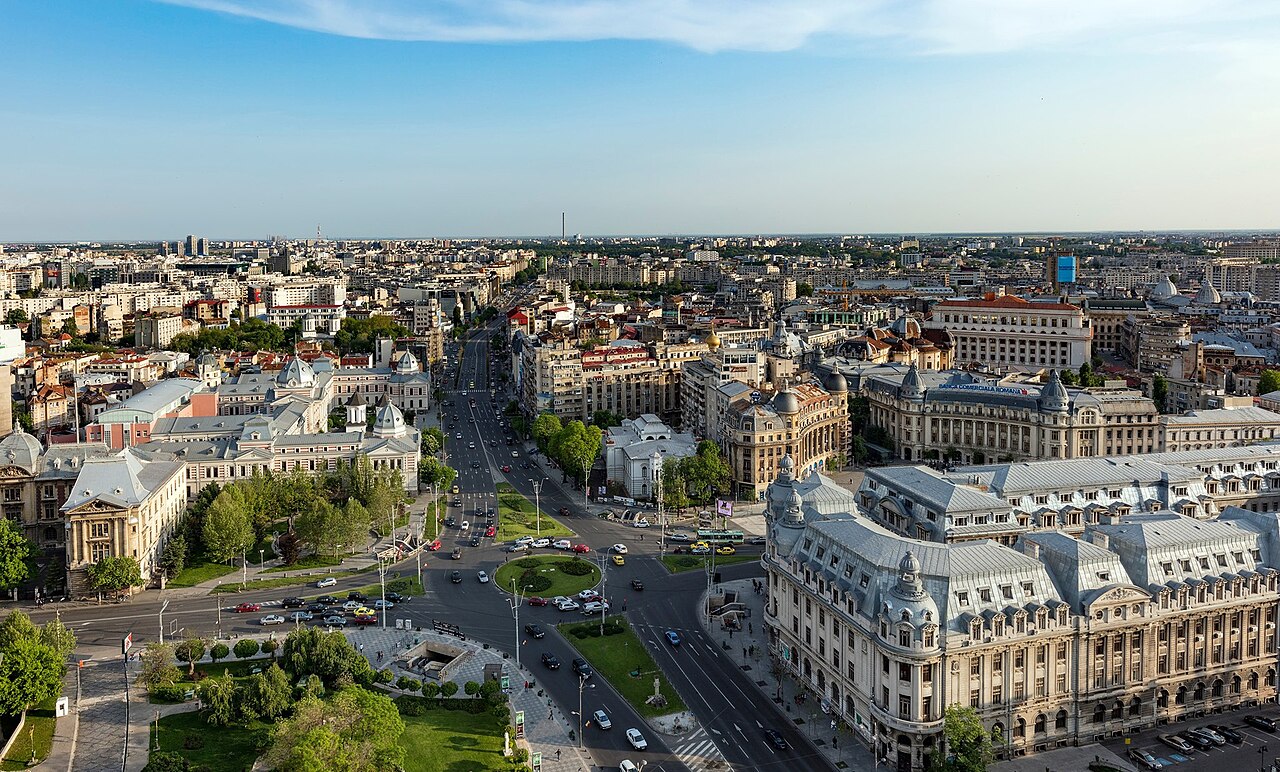
Bucharest University Square
Public domain (Wikimedia Commons)

| Population | 1.8 million (city); 2.2 million (metro) |
| First mentioned | 1459 — Vlad III's citadel |
| Language | Romanian |
| River | Dâmbovița |
| Palace of Parliament | 2nd largest building in world by floor area |
| Revolution | 1989 — bloodiest in Eastern Europe |
History
From Vlad's Citadel to "Little Paris"
Bucharest's first documented mention comes from a 1459 deed signed by Vlad III — known as Vlad the Impaler, the historical figure behind Bram Stoker's Dracula — who used it as a citadel of the principality of Wallachia. The city grew as the capital of Wallachia and then of unified Romania after 1862. By the early 20th century, Bucharest's wide tree-lined boulevards, Parisian-style architecture, and elegant cafés had earned it the nickname "Little Paris of the East" — a title it wore with pride.
Ceaușescu's Destruction
Nicolae Ceaușescu ruled Romania from 1965 to 1989, building a personality cult that rivalled Stalin's in its absurdity. In 1984, inspired by a visit to North Korea's Pyongyang, he ordered the demolition of a vast swathe of historic Bucharest — medieval churches, synagogues, Belle Époque mansions, entire neighbourhoods — to build his grand "Civic Centre." An estimated 40,000 buildings were destroyed, including 19 Orthodox churches and three synagogues. In their place rose the Palace of the Parliament (Casa Poporului): 1,100 rooms, 12 storeys, 365,000 sq metres of floor area — the second-largest administrative building in the world by floor area after the Pentagon. It required 700 architects and 100,000 workers and was never completed to Ceaușescu's vision.
The 1989 Revolution
Romania's revolution was the most violent of the Eastern European transitions of 1989. It began in Timișoara on December 17, when Securitate (secret police) forces fired on protesters. The uprising spread to Bucharest; on December 21, Ceaușescu addressed a crowd from the Central Committee balcony — and was stunned when they booed him. He and his wife Elena fled by helicopter the next day, were captured, subjected to a summary military trial on Christmas Day, and executed by firing squad on December 25, 1989. Over 1,100 people died in the revolution — by far the highest death toll of any 1989 Eastern European transition.
Landmarks
Palace of the Parliament
Whatever one thinks of the politics behind it, the Palace of the Parliament is genuinely staggering. Its scale is hard to comprehend: the building has 1,100 rooms, 480 chandeliers, and enough carpet to cover 30 football pitches. It is the heaviest building in the world — its foundations rest on 21,000 tonnes of steel and 700,000 tonnes of steel beams. Guided tours are available; the view from the rooftop terrace over Ceaușescu's grand boulevard — the Bulevardul Unirii, modelled on the Champs-Élysées — is spectacular.
Old Town (Lipscani)
Miraculously, the Lipscani district — Bucharest's old merchant quarter — survived Ceaușescu's wrecking ball. Today it is a maze of cobblestone streets lined with bars, restaurants, and galleries, making it one of Central Europe's liveliest nightlife districts. The area takes its name from Leipzig (Lipsca in Romanian), reflecting its medieval role in trade with the German city.
Fast Facts
- Bucharest has one of the fastest internet connections in Europe — a legacy of communist-era infrastructure investment
- The city's Arc de Triomphe (1936) is a smaller replica of Paris's original
- Herastrău Park (now King Michael I Park) contains a large lake and the Village Museum — 272 traditional buildings from across Romania
- Bucharest was almost completely destroyed by the 1977 earthquake (magnitude 7.4) — over 1,500 died, and many historic buildings that survived WWII did not survive the quake