Andrew Johnson: Lincoln's Terrible Successor
The tailor's apprentice who became president after Lincoln's assassination — and nearly destroyed Reconstruction. The first impeached president, saved by a single vote.
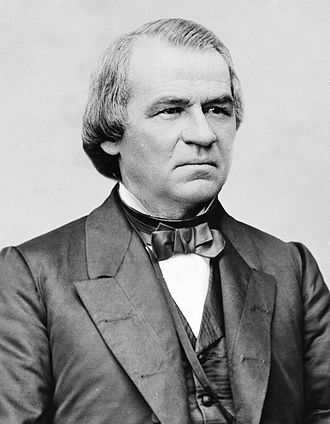
Mathew Brady, c. 1865
Public domain
| Born | December 29, 1808 — Raleigh, North Carolina |
| Died | July 31, 1875 — Carter's Station, Tennessee (age 66) |
| Presidency | 17th President, April 15, 1865 – March 4, 1869 |
| Party | Democratic (ran on National Union ticket in 1864) |
| Spouse | Eliza McCardle (m. 1827) |
| Profession | Tailor, politician |
Early Life and Family
Andrew Johnson was born on December 29, 1808 in Raleigh, North Carolina, to impoverished parents. His father died when Andrew was three; his mother struggled as a weaver and laundress. He was apprenticed to a tailor at 13 and never attended school. He taught himself to read with help from his fellow workers, and his wife Eliza McCardle — whom he married at 18 — helped him learn to write and do arithmetic. He opened his own tailor shop in Greeneville, Tennessee and entered politics through workingmen's advocacy, championing the rights of poor white farmers against the planter aristocracy.
Before the Presidency
Johnson served in the Tennessee legislature, as a U.S. Congressman, as Governor of Tennessee, and as a U.S. Senator. He was the only Southern senator to retain his seat when the Southern states seceded in 1861 — a stance that required genuine courage in Tennessee. This loyalty made him the obvious choice for Lincoln's Vice Presidential running mate in 1864 on the "National Union" ticket, designed to attract border-state and War Democrat votes.
Johnson delivered an embarrassing, apparently intoxicated speech at his Vice Presidential inauguration on March 4, 1865 — Lincoln reportedly told a marshal to keep Johnson away from him. Six weeks later, Lincoln was dead.
The Presidency (1865–1869): The Reconstruction Catastrophe
Betraying the Freedmen
Johnson's Reconstruction policy was built on two convictions: that the Southern states had never legally left the Union and should be readmitted quickly, and that Black Americans were not entitled to political rights. He granted sweeping pardons to former Confederates, restored their lands (including lands that had been distributed to freed Black families), and allowed Southern states to install former Confederate leaders in positions of power. The Black Codes — laws that effectively re-enslaved Black workers through vagrancy laws, labor contracts, and property restrictions — were enacted under his watch.
War with Congress
The Radical Republican Congress responded by passing the Civil Rights Act of 1866, the 14th Amendment, and a series of Reconstruction Acts that placed the South under military governance. Johnson vetoed everything; Congress overrode him. The conflict escalated until Congress passed the Tenure of Office Act, prohibiting the president from removing Senate-confirmed officials without Senate approval. Johnson deliberately violated it by firing Secretary of War Edwin Stanton.
Impeachment
The House voted to impeach Johnson on February 24, 1868 — the first presidential impeachment in American history — on eleven articles related to the Tenure of Office Act violation. The Senate trial ran from March to May 1868. The final vote was 35 guilty, 19 not guilty — one vote short of the two-thirds required for conviction and removal. Seven Republican senators broke with their party to acquit, believing the charges were politically motivated.
📜 Notable Quote
"This is a country for white men, and by God, as long as I am President, it shall be a government for white men."
Johnson's racial views were extreme even by the standards of his era — and they shaped every decision he made about Reconstruction.
📊 How History Rates Andrew Johnson
- C-SPAN Historians Survey (2021): Ranked #41
- Siena College Research Institute (2022): Ranked #42
Johnson is consistently ranked among the worst presidents. His Reconstruction failures had consequences that lasted a century — Jim Crow laws, disenfranchisement, and racial violence that the Civil War was supposed to have ended.
How well do you know the first impeached president?
Put your knowledge to the test.
Take the Andrew Johnson Quiz →