Ulysses S. Grant: The General Who Won the War
He accepted Lee's surrender at Appomattox and brought the Civil War to an end. His presidency was one of the most corrupt in American history — yet historians have recently rehabilitated him.
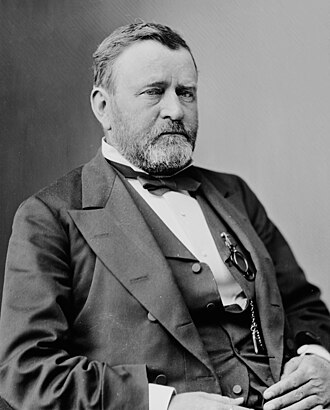
Matthew Brady, c. 1870
Public domain
| Born | April 27, 1822 — Point Pleasant, Ohio |
| Died | July 23, 1885 — Wilton, New York (age 63) |
| Presidency | 18th President, March 4, 1869 – March 4, 1877 |
| Party | Republican |
| Spouse | Julia Dent (m. 1848) |
| Profession | Career military officer |
Early Life and Military Career
Hiram Ulysses Grant was born on April 27, 1822 in Point Pleasant, Ohio (the "S." was a clerical error at West Point that he never bothered to correct — it stood for nothing). His father Jesse was an ambitious tanner who secured his son an appointment to West Point. Grant graduated in 1843 in the middle of his class — undistinguished academically but exceptional on horseback, setting a high-jump record that stood for 25 years.
His pre-Civil War civilian career was a series of failures. He left the Army in 1854 — possibly to avoid a drinking problem — and struggled as a farmer, bill collector, and clerk in his father's leather shop. When the Civil War began, he was working for his brothers in Galena, Illinois, earning modest wages. He was 39 years old.
The Civil War
Grant's military transformation was rapid and decisive. He drilled Illinois volunteers, then won the first significant Union victory of the war at Fort Donelson in February 1862 — earning the nickname "Unconditional Surrender" Grant when he rejected a Confederate request for negotiation terms. He survived the near-disaster at Shiloh (April 1862), won the brilliantly conceived Vicksburg Campaign (1863) — the strategic masterpiece that split the Confederacy — and was appointed General-in-Chief by Lincoln in March 1864.
His Overland Campaign of 1864 was brutal and costly — Cold Harbor alone cost 7,000 Union casualties in an hour — but it ground Lee's army down relentlessly. At Appomattox Court House on April 9, 1865, Grant accepted Lee's surrender in terms that were generous by the standards of the era: Confederate officers kept their sidearms; soldiers kept their horses for the spring plowing.
The Presidency (1869–1877)
Civil Rights and Reconstruction
Grant's presidency had genuine achievements that his corruption scandals obscure. He enforced the 15th Amendment aggressively, prosecuting the Ku Klux Klan through the Enforcement Acts (1870–71) and effectively destroying it as a political force for a generation. He appointed more Black Americans to federal office than any previous president. He sought (unsuccessfully) to annex Santo Domingo as a refuge for Black Americans fleeing Southern violence.
The Scandals
Grant was not personally corrupt, but his loyalty to friends and associates who were proved catastrophic. The major scandals of his administration included: Black Friday (1869) — financiers Jay Gould and James Fisk tried to corner the gold market using White House connections; Crédit Mobilier (1872) — a railroad construction fraud that implicated members of Congress; and the Whiskey Ring (1875) — a massive conspiracy by Treasury officials and distillers to defraud the government of whiskey tax revenues, netting over $3 million. Grant's private secretary Orville Babcock was indicted; Grant testified on his behalf.
Memoirs and Death
Grant's post-presidential years were as dramatic as his wartime career. He was swindled out of his life savings by a business partner and diagnosed with terminal throat cancer in 1884. He spent his final months racing to complete his Personal Memoirs — dictating 275,000 words while in agonizing pain — to provide for his family. He finished them just days before his death on July 23, 1885. Published by Mark Twain, the memoirs sold 300,000 copies and are considered among the finest military memoirs in American literature.
📜 From the Appomattox Terms (1865)
"The war is over. The rebels are our countrymen again."
Grant's response when his troops began to cheer Lee's surrender — stopping the celebration because he felt it was wrong to exult over the defeat of a fellow American.
📊 How History Rates Ulysses S. Grant
- C-SPAN Historians Survey (2021): Ranked #20
- Siena College Research Institute (2022): Ranked #16
Grant's ranking has risen significantly in recent decades as historians reassess his civil rights record. He was once ranked in the bottom tier; now he sits in the middle — a reflection of a more complete picture of his presidency.
How well do you know the general who won the Civil War?
Put your knowledge to the test.
Take the Ulysses S. Grant Quiz →