Abraham Lincoln: The Indispensable President
Born in a log cabin, self-taught lawyer, saviour of the Union. The man who ended slavery and redefined American democracy in 272 words — and was killed before he could finish the work.
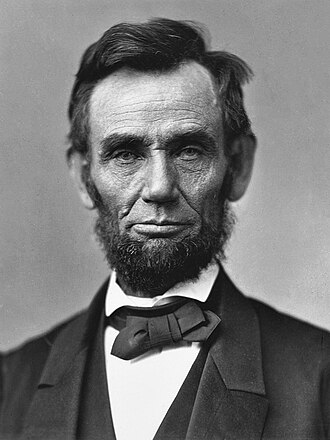
Alexander Gardner, 1863
Public domain
| Born | February 12, 1809 — Hardin County, Kentucky |
| Died | April 15, 1865 — Washington, D.C. (age 56) |
| Presidency | 16th President, March 4, 1861 – April 15, 1865 |
| Party | Republican |
| Spouse | Mary Todd (m. 1842) |
| Profession | Self-taught lawyer, Illinois politician |
Early Life and Family
Abraham Lincoln was born on February 12, 1809 in a one-room log cabin in Hardin County, Kentucky. His father Thomas was a subsistence farmer; his mother Nancy Hanks Lincoln died of milk sickness when Abraham was nine. His stepmother Sarah Bush Johnston proved a vital influence — she encouraged his reading and referred to him as the best boy she had ever known.
Lincoln had approximately 18 months of formal schooling in total. He educated himself by reading every book he could borrow, by firelight, in a frontier environment where books were scarce. He read the Bible, Aesop's Fables, John Bunyan, and Shakespeare repeatedly, developing a prose style of extraordinary clarity and rhythm. He taught himself law by reading Blackstone's Commentaries and was admitted to the Illinois bar in 1836.
His marriage to Mary Todd in 1842 was tumultuous. Mary was brilliant, politically astute, and prone to volatile moods. They had four sons; only Robert survived to adulthood. The death of Willie in the White House in 1862 devastated both parents.
Before the Presidency
Lincoln served four terms in the Illinois state legislature and one term in Congress (1847–49), where he opposed the Mexican-American War and challenged Polk over the justification for it. He then largely withdrew from politics until the Kansas-Nebraska Act of 1854 galvanized him back. His 1858 Senate debates with Stephen Douglas — seven encounters across Illinois — elevated him to national prominence despite losing the Senate race. His Cooper Union address in February 1860 made him a serious presidential contender; his nomination at the Republican convention in Chicago that May surprised many.
The Presidency (1861–1865)
The Civil War
Lincoln inherited a nation already fracturing. Seven states had seceded before his inauguration. Confederate forces fired on Fort Sumter on April 12, 1861, beginning the Civil War. Lincoln's first challenge was simply keeping the border states — Kentucky, Missouri, Maryland, Delaware — in the Union. He suspended habeas corpus, instituted a naval blockade, and called for 75,000 volunteers — all before Congress was in session.
His generalship search was agonizing. He went through McClellan (twice), Burnside, Hooker, Meade, and finally found his general in Ulysses S. Grant. Lincoln's strategic vision — strangling the Confederacy economically through blockade while pressing simultaneously on all fronts — was sound from the beginning, but finding generals willing and able to execute it took years.
The Emancipation Proclamation
On January 1, 1863, Lincoln issued the Emancipation Proclamation, declaring enslaved people in Confederate states in rebellion to be free. It was deliberately limited — it did not free enslaved people in loyal border states or in Union-controlled areas of the South — but its moral and strategic significance was enormous. It reframed the war's purpose, discouraged European intervention on behalf of the Confederacy, and opened the door to Black enlistment in the Union Army. Over 180,000 Black soldiers would serve.
Gettysburg and the Second Inaugural
Lincoln delivered the Gettysburg Address on November 19, 1863, at the dedication of the Soldiers' National Cemetery. In 272 words, he redefined the war and American democracy itself: "that this nation, under God, shall have a new birth of freedom." His Second Inaugural Address (March 4, 1865) — "With malice toward none, with charity for all" — remains one of the greatest speeches in any language.
Assassination
On the evening of April 14, 1865 — just five days after Lee's surrender at Appomattox — Lincoln attended a performance of Our American Cousin at Ford's Theatre in Washington. Actor John Wilkes Booth, a Confederate sympathiser, shot him in the back of the head at close range. Lincoln died the following morning, April 15, at 7:22 a.m. He was 56 years old. He never regained consciousness. Secretary of War Stanton reportedly said at the moment of death: "Now he belongs to the ages."
📜 From the Gettysburg Address (1863)
"Four score and seven years ago our fathers brought forth on this continent, a new nation, conceived in Liberty, and dedicated to the proposition that all men are created equal."
272 words that redefined what America was fighting for — and what it was supposed to be.
📊 How History Rates Abraham Lincoln
- C-SPAN Historians Survey (2021): Ranked #1
- Siena College Research Institute (2022): Ranked #1
- American Political Science Association (2018): Ranked #1
Lincoln is the unanimous consensus as the greatest American president across every major historical survey — for saving the Union, ending slavery, and demonstrating what democratic leadership can achieve under the most extreme pressure.
How well do you know America's greatest president?
Put your knowledge to the test.
Take the Abraham Lincoln Quiz →