Tallinn: Capital of Estonia
A perfectly preserved medieval city that became one of the world's most digital nations — home to the world's oldest continuously operating pharmacy (since 1422), Skype's birthplace, and online voting since 2005.
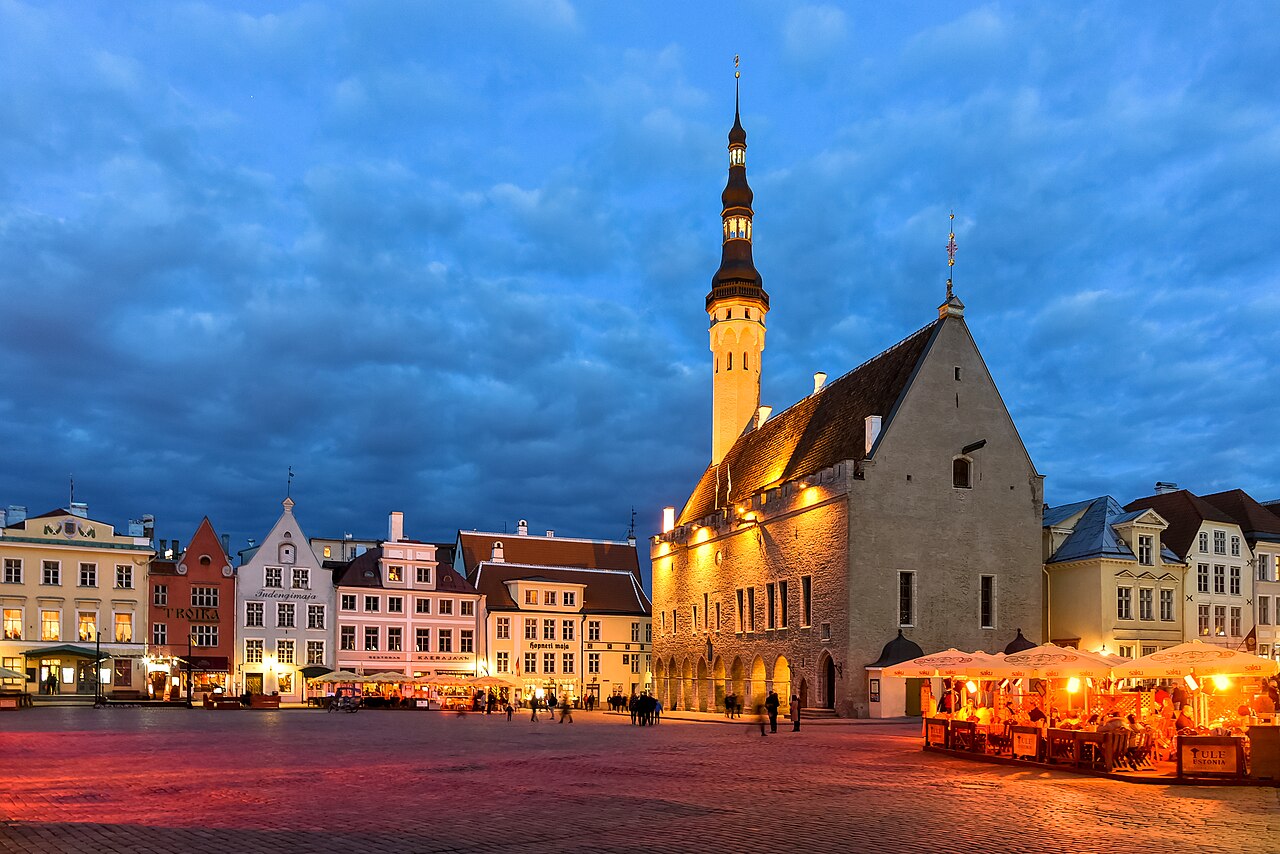
Tallinn old town from Kohtuotsa viewpoint
Public domain (Wikimedia Commons)
| First recorded | 1154 (Arab map) |
| Population | ~455,000 |
| UNESCO | Historic Centre (1997) |
| Language family | Finno-Ugric (related to Finnish) |
| Skype founded | Tallinn, 2003 |
History
Danish Castle, Hanseatic City
Tallinn's name likely derives from Taani linn — "Danish castle." The Danes sold the territory to the Teutonic Knights in 1346, and the city — then known as Reval — grew into a prosperous Hanseatic trading hub on the Gulf of Finland, a crucial link between western Europe and Russia.
The Singing Revolution
Estonia was occupied by the Soviet Union in 1940, then Nazi Germany 1941–44, then the Soviets again until 1991. The independence movement of the late 1980s became known as the Singing Revolution — mass song festivals where hundreds of thousands gathered to sing forbidden national songs as their primary vehicle of resistance. Estonia declared independence on August 20, 1991.
Landmarks & Culture
The Medieval Old Town
Tallinn's old town is one of the best-preserved medieval cities in Northern Europe — UNESCO since 1997. The upper town (Toompea) on a limestone cliff houses the castle and churches; the lower town belonged to merchants. The contrast between these two worlds, separated by ancient gates and towers, is remarkably intact after 700 years.
Kiek in de Kök
"Peek into the Kitchen" in Low German — this 15th-century artillery tower was reportedly so tall that guards could look down into the kitchens of nearby houses. One of the best-preserved medieval military towers in the Baltic, it is one of Tallinn's most charming landmarks.
World's Oldest Pharmacy
The Town Hall Pharmacy on Raekoja plats has operated continuously since 1422 — over 600 years in the same building. In medieval times it stocked remedies including powdered unicorn horn and burnt bees. Today it sells modern medicines, but the historic interior remains. It is still open for business.
Digital Estonia
Skype was founded in Tallinn in 2003. Estonia became the first country to hold national elections online — in 2005. The e-residency program (2014) allows anyone globally to become a digital resident and run an EU company remotely. 99% of public services are online. Often called the world's most digital nation.
Fast Facts
- Estonians are Finno-Ugric — ethnically related to Finns and Hungarians, not to their Latvian and Lithuanian neighbours.
- Tallinn's old town walls — 1.9 km — are largely intact, with 26 of the original 46 towers still standing.
- Estonia has more start-ups per capita than almost any country in Europe.
- Over 50% of Estonia is forested — lynx, wolves, and brown bears roam freely.
📊 Estonia in Numbers
- Town Hall Pharmacy operating since: 1422 (600+ years)
- First online national election: 2005
- E-residents worldwide: 100,000+
- Baltic Way participants: ~2 million across three countries