Paris: The City of Light
Capital of France, most visited city on Earth, birthplace of revolution and haute couture. Two thousand years of history on an island in the Seine.
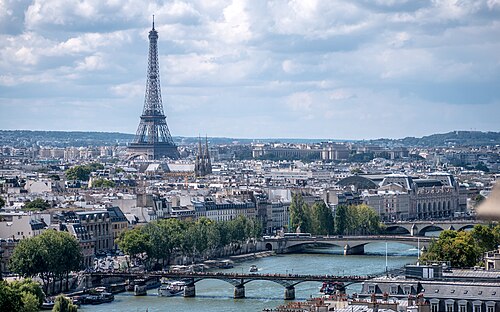
Eiffel Tower from Tour Saint-Jacques
Public domain (Wikimedia Commons)

| Population | 2.1 million (city); 12 million (metro) |
| Founded | c. 250 BC by the Celtic Parisii tribe |
| Language | French |
| Capital since | 987 AD (Capetian dynasty) |
| Area | 105 km² (city proper) |
| Olympics | 1900, 1924, 2024 |
History
Origins: Lutetia on the Seine
Paris began as a Celtic settlement of the Parisii tribe on an island in the Seine — today's Île de la Cité — around 250 BC. The Romans conquered it in 52 BC and renamed it Lutetia, building baths, an amphitheatre, and a forum on the Left Bank. When the Western Roman Empire crumbled, the Frankish king Clovis I made Paris his capital in 508 AD, cementing its position at the heart of what would become France.
By the 12th century Paris was one of Europe's largest cities. The University of Paris, founded around 1150, became one of the first universities in the world — a magnet for scholars from across Christendom. Notre-Dame Cathedral was begun in 1163 and took over 180 years to complete.
Revolution and Transformation
On July 14, 1789, Parisian crowds stormed the Bastille prison — the moment that sparked the French Revolution. The following decade transformed not just France but the political map of Europe. Louis XVI and Marie Antoinette were guillotined in the Place de la Révolution (now Place de la Concorde). Napoleon Bonaparte emerged from the revolutionary chaos, crowned himself Emperor in Notre-Dame in 1804, and set about reshaping the city — and then the continent.
The Paris that tourists recognise today is largely the creation of Baron Haussmann, who between 1853 and 1870 demolished medieval neighbourhoods and drove grand boulevards through the city's fabric on the orders of Napoleon III. The transformation was brutal and controversial — hundreds of thousands were displaced — but it created the wide avenues, uniform façades, and green parks that define the city's character.
Landmarks
The Eiffel Tower
Designed by Gustave Eiffel and built in just 26 months, the tower was completed in March 1889 for the Exposition Universelle (World's Fair) — a celebration of the centenary of the French Revolution. It stood at 300 metres, making it the world's tallest structure for 41 years. Parisians were divided — many found it an eyesore and called it la tour en fer forgé (the iron scaffolding). A petition of artists and writers protested its construction. It was slated for demolition in 1909 but was saved by its usefulness as a radio transmission tower — a function that made it militarily invaluable and kept it standing.
The Louvre
Originally a 12th-century fortress, then a royal palace, the Louvre became a public museum in 1793 during the Revolution. Today it holds over 380,000 objects and receives nearly 10 million visitors a year — making it the world's most visited art museum. Its collection spans 9,000 years: from ancient Mesopotamian artefacts to Leonardo da Vinci's Mona Lisa, from the Venus de Milo to Vermeer's The Lacemaker. The glass pyramid entrance, designed by I.M. Pei and opened in 1989, was itself initially controversial and is now iconic.
Notre-Dame de Paris
Construction began in 1163 under Bishop Maurice de Sully and was largely complete by 1345. The cathedral is a masterpiece of French Gothic architecture — its flying buttresses, rose windows, and gargoyles have defined the style for centuries. On April 15, 2019, a catastrophic fire destroyed the spire and most of the roof. The reconstruction — a landmark project involving hundreds of craftspeople — was completed in time for the 2024 Paris Olympics, and the cathedral reopened in December 2024.
The Champs-Élysées and Arc de Triomphe
The Avenue des Champs-Élysées runs 1.9 km from the Place de la Concorde to the Arc de Triomphe. Napoleon commissioned the Arc in 1806 to honour the Grande Armée; it wasn't completed until 1836, eleven years after his death. Beneath it lies the Tomb of the Unknown Soldier, with an eternal flame lit in 1923. The Champs-Élysées — once a marshy field — became the world's most famous avenue and hosts the finish line of the Tour de France each July.
Culture and Character
Paris gave the world Impressionism (Monet, Renoir, Degas), the French New Wave in cinema (Godard, Truffaut), modern haute couture (Chanel, Dior, Balenciaga), and the existentialist philosophy of Sartre and de Beauvoir — who wrote much of their work in the Café de Flore in Saint-Germain-des-Prés. The city's café culture, its arrondissements, its markets and boulangeries, and its reputation for a certain indifference to tourists have become part of its international personality.
📜 Notable Quote
"Paris is always a good idea."
Attributed to Audrey Hepburn — though its true origin is disputed, the sentiment is universally agreed upon.
Fast Facts
- The Métro has 302 stations — more stops per km² than any other metro system in the world
- Paris has more Michelin-starred restaurants than any other city (over 130)
- The city has 37 bridges across the Seine within the city limits
- The Catacombs hold the remains of approximately 6 million people in former limestone quarries beneath the city
- Paris has been continuously inhabited for over 2,000 years — one of the longest-occupied sites in Western Europe
- The Eiffel Tower grows by up to 15 cm in summer as the iron expands in heat
📊 Paris in Numbers
- Most visited city in the world — 50+ million tourists annually
- Louvre: ~9.7 million visitors/year (world's most visited museum)
- Eiffel Tower: ~7 million visitors/year
- Notre-Dame: ~13 million visitors/year before the 2019 fire
- City age: over 2,270 years of continuous habitation