Berlin: Capital of Germany
Divided by a wall, reunited by history. Berlin has been capital of empires, dictatorships, and democracy. One of the most historically charged cities in Europe.
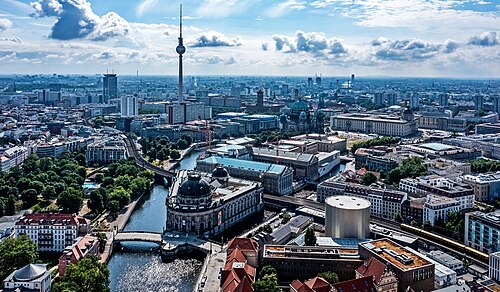
Brandenburg Gate at dusk
Public domain (Wikimedia Commons)
| Population | 3.7 million (city) |
| Founded | 13th century on the Spree river |
| Language | German |
| Capital since | 1871 (German Empire); reunified 1991 |
| Wall built | 1961; fell 1989 |
| Museums | Over 170 — more than any other city |
History
From Prussia to Empire
Berlin was founded in the 13th century at the confluence of the Spree and Havel rivers. It rose to prominence as the capital of Brandenburg-Prussia and in 1701 became the capital of the Kingdom of Prussia. After Prussia's decisive role in unifying Germany, Berlin became the capital of the German Empire in 1871 under Kaiser Wilhelm I and Chancellor Otto von Bismarck. By 1900 it was one of Europe's great industrial and cultural capitals.
Weimar, Nazi Rule, and Division
After Germany's defeat in WWI, Berlin became capital of the Weimar Republic — a brief, turbulent democracy that produced extraordinary culture (Brecht, the Bauhaus, expressionist cinema) alongside political violence. When Adolf Hitler became chancellor in 1933, Berlin became the centre of Nazi power. WWII left much of the city in ruins. The victorious Allies divided it into four sectors; in 1961, the East German government erected the Berlin Wall to stop its citizens fleeing westward.
The Wall and Reunification
The Berlin Wall — 155 km of concrete, wire, and guard towers — stood for 28 years. On the night of November 9, 1989, following an East German press conference blunder, crowds gathered at checkpoints and guards, overwhelmed, stood aside. East Berliners poured through. Germany was officially reunified on October 3, 1990; Berlin was re-established as the federal capital in 1991, though the government did not fully relocate from Bonn until 1999.
Landmarks
The Brandenburg Gate
Built between 1788 and 1791, the Brandenburg Gate is Berlin's most iconic monument. During the Cold War it stood in the no-man's-land between East and West — visible but unreachable from either side. Today it is the symbol of German reunification. It was here that US President Ronald Reagan delivered his famous "Tear down this wall!" speech in 1987.
Museum Island
Museum Island (Museumsinsel) — a UNESCO World Heritage Site — contains five world-class museums clustered on an island in the Spree: the Pergamon Museum (home to the reconstructed Pergamon Altar and the Ishtar Gate of Babylon), the Neues Museum (Egyptian collection, including the bust of Nefertiti), the Alte Nationalgalerie, the Altes Museum, and the Bode Museum. Together they hold one of the world's great collections of antiquity.
The Reichstag
The German parliament building, built in 1894, was notoriously set ablaze in 1933 — an event the Nazis used as a pretext to seize emergency powers. After reunification it was rebuilt with a spectacular glass dome designed by Norman Foster, allowing visitors to look down into the plenary chamber below — a deliberate statement about government transparency.
Culture
Modern Berlin has reinvented itself as Europe's creative capital. Its club scene — centred on former industrial spaces like Berghain — is internationally influential. The city has more galleries than any other in Europe, a thriving tech startup scene, and one of the continent's most diverse populations. It is also, famously, arm aber sexy ("poor but sexy") in the words of former mayor Klaus Wowereit — a city that has monetised its history, its scars, and its underground culture into a global brand.
📜 Notable Quote
"Berlin is a city condemned always to become, never to be."
Karl Scheffler, Berlin — Ein Stadtschicksal, 1910 — still apt today.
Fast Facts
- Berlin has more bridges than Venice — over 1,700
- The city has nine major airports in its metro history; it now has one: BER, opened in 2020
- Berlin is nine times larger by area than Paris
- The bear on Berlin's coat of arms has appeared on the city seal since 1280
- Over 2.5 million trees grow within the city limits