Minsk: Capital of Belarus
Almost completely destroyed in WWII and rebuilt in monumental Stalinist style. Capital of Belarus, seat of the post-Soviet CIS, and the place where the USSR was dissolved.
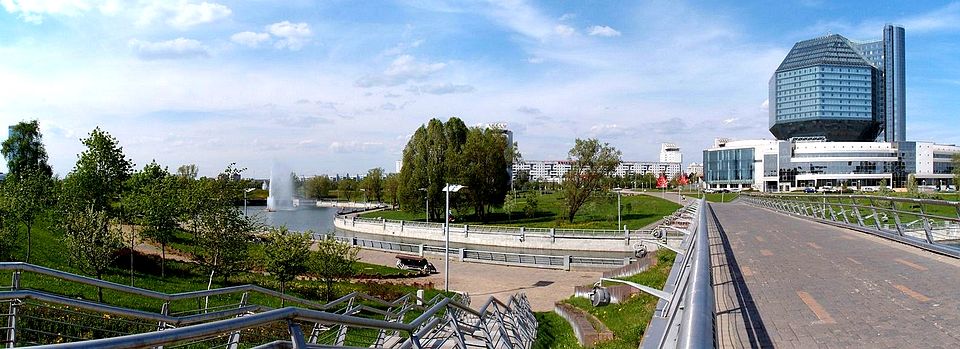
The diamond-shaped National Library of Belarus
Public domain (Wikimedia Commons)
| Population | ~2 million |
| River | Svislach |
| Languages | Belarusian & Russian |
| First mentioned | 1067 |
| Rebuilt | After near-total WWII destruction |
| CIS headquarters | Since 1991 |
History
Lithuanian and Polish centuries
Minsk was first mentioned in 1067 and for most of its history lay far from Russia. From the 14th century it was part of the Grand Duchy of Lithuania, and later the Polish–Lithuanian Commonwealth — a multi-ethnic state that shaped Belarusian identity. The city passed to the Russian Empire only in 1793, during the Second Partition of Poland.
Destruction and rebirth
World War II was catastrophic for Belarus, which lost a quarter to a third of its entire population — among the highest proportional losses of any nation. Minsk was almost completely destroyed under Nazi occupation (1941–44). After the war it was rebuilt from scratch in grand Stalinist style; Independence Avenue, a sweeping boulevard of monumental façades, is one of the finest surviving examples of the style in the world.
The end of the USSR
In December 1991, leaders of Russia, Ukraine, and Belarus met in the Belovezhskaya Pushcha forest near Minsk and signed the Belovezha Accords, formally dissolving the Soviet Union and creating the Commonwealth of Independent States (CIS) — which is headquartered in Minsk to this day.
Landmarks
National Library of Belarus
The defining image of modern Minsk is the National Library, opened in 2006 — a 72-metre rhombicuboctahedron, a 24-faceted glass "diamond" that glows with light displays at night. An observation deck near the top offers panoramic views over the city.
Independence Avenue
Independence Avenue (Praspiekt Niezaliežnasci) runs for some 15 kilometres through the heart of the city, lined with monumental post-war buildings, squares, and government palaces. It is the showcase of Minsk's Stalinist reconstruction and a candidate for UNESCO World Heritage status.
Fast Facts
- Belarus has two official languages: Belarusian and Russian
- Minsk is home to about a fifth of the country's entire population
- The USSR was formally dissolved in a forest near Minsk in 1991
- The city is one of Europe's least-visited capitals by foreign tourists
- For centuries Minsk was part of Lithuania and Poland, not Russia