Copenhagen: Capital of Denmark
Home to the Little Mermaid, the world's oldest operating amusement park, and the restaurant that defined New Nordic cuisine. Copenhagen also invented the concept of "hygge" and consistently ranks among the world's most liveable cities.
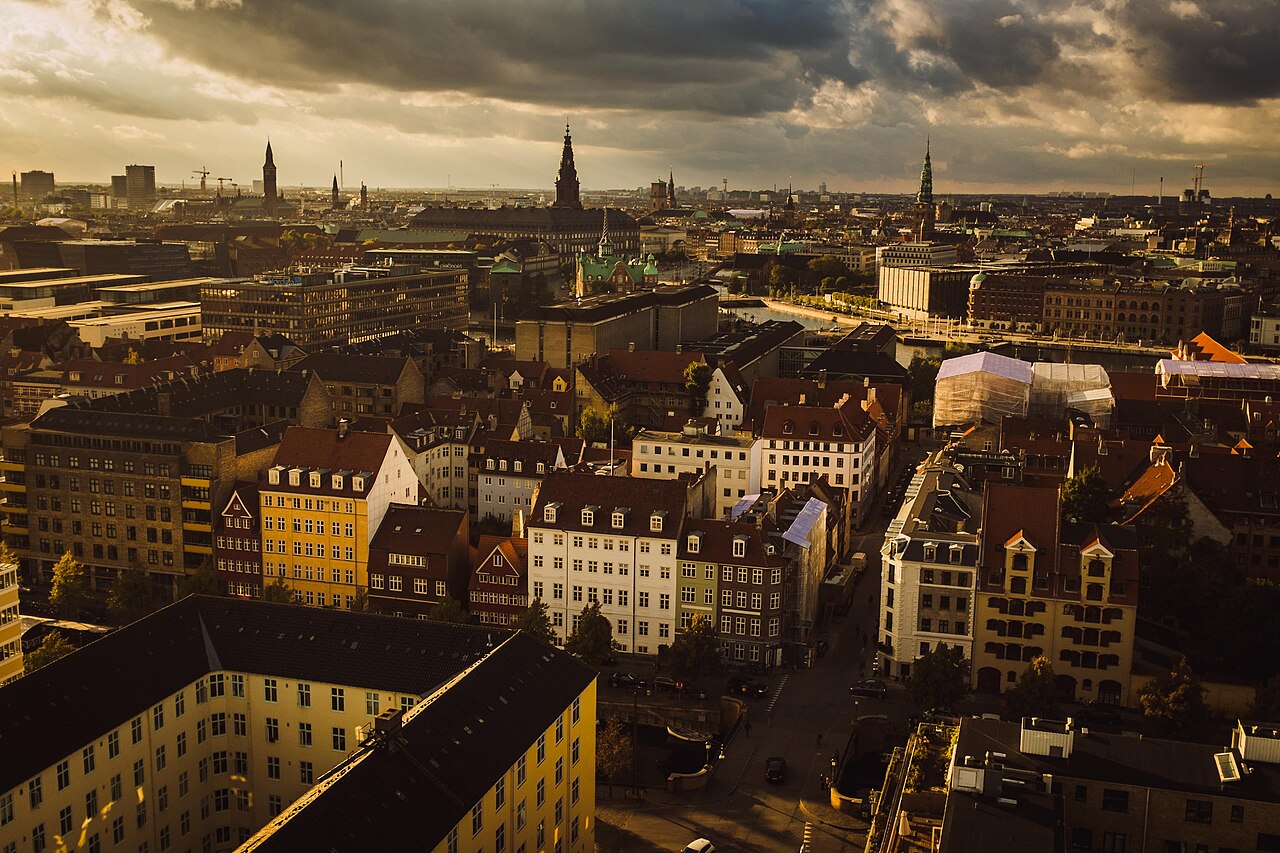
Nyhavn canal district
Public domain (Wikimedia Commons)

| Population | 800,000 (city); 1.4 million (metro) |
| Founded | c. 1000 Viking harbour; capital 1443 |
| Language | Danish |
| Cycling | ~62% commute by bike daily |
| Climate target | First carbon-neutral capital by 2025 |
History
Viking Harbour to Nordic Capital
Copenhagen began as a Viking fishing village around 1000 AD at a natural harbour on the island of Zealand (Sjælland). Its name derives from Køpmannæhavn — "merchants' harbour." The city grew rapidly as a trading centre; Denmark controlled the strategically vital Øresund strait between the Baltic and North Seas for centuries, extracting tolls from every passing ship. Copenhagen became Denmark's capital in 1443 and the dominant city in Scandinavia. The city was heavily bombarded by the British Royal Navy in 1807 during the Napoleonic Wars — Britain seized the Danish fleet to prevent it falling to Napoleon.
Hans Christian Andersen
Hans Christian Andersen (1805–1875) was born in Odense but made his career in Copenhagen. His fairy tales — The Little Mermaid, The Ugly Duckling, Thumbelina, The Snow Queen, The Emperor's New Clothes — have been translated into more languages than any book except the Bible. The Snow Queen was the primary inspiration for Disney's Frozen (2013). The Little Mermaid bronze statue on a rock in Copenhagen harbour (1913, by sculptor Edvard Eriksen) has become one of Denmark's most visited landmarks — and, ironically, one of the most frequently vandalised.
Landmarks
Tivoli Gardens
Tivoli Gardens, opened in 1843, is often described as the world's oldest amusement park still in operation — though technically Denmark's Dyrehavsbakken (1583) is older. Tivoli is, however, the most famous and influential. Walt Disney visited Tivoli while planning Disneyland in the 1950s and was inspired by its blend of rides, gardens, restaurants, and entertainment. Tivoli is illuminated with over 100,000 lights in the evening and receives 4 million visitors annually.
Nyhavn and Christiania
Nyhavn ("New Harbour") — the colourful 17th-century canal district with its painted townhouses — is Copenhagen's most photographed streetscape. Hans Christian Andersen lived at No. 20 for years. A short walk away, Christiania is a self-proclaimed autonomous district established in 1971 by squatters in abandoned military barracks. Its ~1,000 residents operate under their own rules; the district is famous for its open cannabis market on Pusher Street (technically illegal), its car-free streets, and its colourful murals.
Noma and New Nordic Cuisine
In 2003, chef René Redzepi opened Noma in a Copenhagen waterfront warehouse. The restaurant — ranked the world's best restaurant four times — defined the New Nordic cuisine movement: foraging for local ingredients, fermentation, minimal processing, and a radical rethinking of what Nordic food could be. Noma closed in 2024, but its influence on global gastronomy is permanent.
Fast Facts
- Copenhagen's metro system, opened 2002, is entirely automated (driverless)
- The word "hygge" — a Danish/Norwegian concept of cosiness and convivial wellbeing — became a global phenomenon after 2016
- Lego was invented in Billund, Denmark in 1932 — the name comes from leg godt ("play well" in Danish)
- Kronborg Castle in nearby Helsingør (30 km north) is the setting for Shakespeare's Hamlet — though Shakespeare never visited Denmark
- Denmark consistently ranks in the top 3 happiest countries in the UN World Happiness Report