Franklin Pierce: The President Who Set America on Fire
Handsome, charming, personally devastated — and politically catastrophic. Pierce signed the Kansas-Nebraska Act and accelerated America toward Civil War.
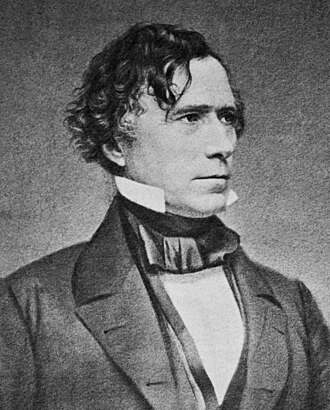
George Peter Alexander Healy, 1858
Public domain
| Born | November 23, 1804 — Hillsborough, New Hampshire |
| Died | October 8, 1869 — Concord, New Hampshire (age 64) |
| Presidency | 14th President, March 4, 1853 – March 4, 1857 |
| Party | Democratic |
| Spouse | Jane Means Appleton (m. 1834) |
| Profession | Lawyer, politician, military officer |
Early Life and Family
Franklin Pierce was born on November 23, 1804 in Hillsborough, New Hampshire, the son of a Revolutionary War veteran and future Governor of New Hampshire. He graduated from Bowdoin College in 1824 — in the same class as Nathaniel Hawthorne, who became his lifelong friend and wrote his campaign biography. Pierce was famously handsome, charming, and socially magnetic — the most conventionally attractive man to hold the presidency.
His marriage to Jane Means Appleton was troubled. Jane was intensely religious, chronically ill, and deeply opposed to politics. She fainted when she learned of Pierce's presidential nomination. The couple suffered the loss of three sons: the first died as an infant, the second died at age 4, and the third — Bennie, age 11 — was killed in a train accident on January 6, 1853, just two months before Pierce's inauguration. Pierce and Jane witnessed Bennie's death. Jane concluded that God had taken Bennie so that Pierce could devote himself entirely to the presidency. Pierce entered office in a state of profound grief and guilt.
The Presidency (1853–1857)
The Kansas-Nebraska Act
Pierce's presidency was defined almost entirely by one catastrophic decision: supporting the Kansas-Nebraska Act of 1854, authored by Illinois Senator Stephen Douglas. The Act organized the Kansas and Nebraska territories under the principle of "popular sovereignty" — allowing settlers to vote on whether to permit slavery — which effectively repealed the Missouri Compromise of 1820, which had prohibited slavery north of the 36°30' line.
The consequences were immediate and violent. Pro-slavery and anti-slavery settlers poured into Kansas, each trying to establish political control. The result was "Bleeding Kansas" — years of guerrilla warfare, electoral fraud, and political violence that served as a direct preview of the Civil War. The Act also destroyed the Whig Party and gave birth to the Republican Party, founded in 1854 specifically to oppose slavery's expansion.
Other Foreign Policy Ambitions
Pierce harbored expansionist ambitions beyond Kansas. The Ostend Manifesto (1854) — a secret dispatch suggesting the U.S. should seize Cuba from Spain if Spain refused to sell it — became public and caused a diplomatic scandal that further damaged Pierce's already weakened presidency.
Denial and Legacy
Pierce was denied renomination by his own party in 1856 — replaced by James Buchanan. He spent his later years as an increasingly bitter, pro-Southern critic of Lincoln and the war effort. When Lincoln was assassinated, a mob gathered outside Pierce's home in Concord demanding to know why he had not flown a flag at half-staff. He died in 1869, largely forgotten, in the state he had represented.
📜 Notable Quote
"There is nothing left to do but get drunk."
Pierce's reported response when asked what a former president does. He struggled with alcoholism throughout his post-presidential years.
📊 How History Rates Franklin Pierce
- C-SPAN Historians Survey (2021): Ranked #40
- Siena College Research Institute (2022): Ranked #40
Pierce consistently ranks among the bottom three presidents in all surveys. His personal tragedy earns sympathy; the Kansas-Nebraska Act earns condemnation.
How well do you know the president who ignited Bleeding Kansas?
Put your knowledge to the test.
Take the Franklin Pierce Quiz →