Andrew Jackson: The People's President
War hero, populist icon, Indian killer. The man who democratised American politics and left a trail of atrocities doing it.
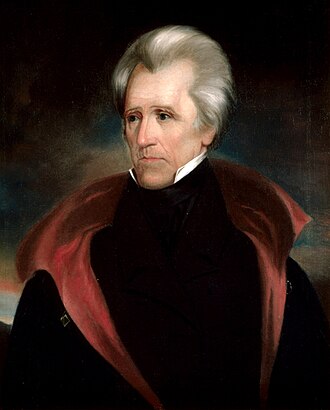
Ralph E. W. Earl, c. 1835
Public domain
| Born | March 15, 1767 — Waxhaws, SC/NC border |
| Died | June 8, 1845 — Nashville, Tennessee (age 78) |
| Presidency | 7th President, March 4, 1829 – March 4, 1837 |
| Party | Democrat (founder) |
| Spouse | Rachel Donelson Robards (m. 1791, d. 1828) |
| Profession | Soldier, lawyer, planter, politician |
Early Life and Family
Andrew Jackson was born on March 15, 1767 in the Waxhaws region on the border of North and South Carolina, into a Scots-Irish immigrant family. His father died before he was born; his mother and both brothers died during or shortly after the Revolutionary War. Jackson himself was captured by British forces at 13 and slashed across the face with a sword by an officer whose boots he refused to clean — a scar he carried for life, along with a permanent hatred of the British.
He studied law and moved to Nashville, Tennessee, where he became a successful lawyer, land speculator, and planter. His marriage to Rachel Donelson was complicated by the fact that her divorce from her first husband was not finalised when they first married in 1791 — a scandal that dogged Jackson throughout his career and which he believed contributed to Rachel's death shortly before his inauguration in 1829. He never forgave his political enemies for what they said about her.
Before the Presidency
Military Hero
Jackson rose to national fame through the Battle of New Orleans in January 1815 — a decisive American victory fought two weeks after the peace treaty ending the War of 1812 had already been signed (news hadn't arrived yet). With a mixed force of regulars, militiamen, pirates, and free Black soldiers, Jackson repelled a much larger British force with minimal American casualties. He became the most celebrated military hero since Washington.
Earlier, he had commanded the brutal Creek War (1813–14), defeating the Red Sticks faction of the Creek Nation at the Battle of Horseshoe Bend and seizing 23 million acres of Creek land.
The Presidency (1829–1837)
What He Built
- Jacksonian Democracy: Expanded voting rights to nearly all white men by eliminating property requirements. Transformed American politics into a genuine mass democracy — at least for white men.
- Nullification Crisis (1832–33): When South Carolina declared federal tariffs null and void, Jackson threatened military force and secured a compromise. His assertion of federal supremacy over states was decisive and precedent-setting.
- Paid off the national debt: The only president in U.S. history to pay off the entire national debt — achieved in January 1835, though the resulting economic instability contributed to the Panic of 1837.
Controversies and Failures
- Indian Removal Act (1830) and the Trail of Tears: Jackson signed legislation forcing the Cherokee, Creek, Choctaw, Chickasaw, and Seminole nations off their ancestral lands in the Southeast. Tens of thousands were forcibly marched west; thousands died on the trail. The Supreme Court ruled the removal of the Cherokee unconstitutional — Jackson reportedly said "John Marshall has made his decision; now let him enforce it."
- Destruction of the Second Bank: Jackson vetoed the re-charter of the Second Bank of the United States, distributing federal funds to state banks. The resulting financial instability contributed directly to the Panic of 1837.
- Slavery: Jackson enslaved over 150 people and was an active defender of slavery as an institution.
Death
Jackson died on June 8, 1845 at his Hermitage estate near Nashville, Tennessee. He was 78 and had been in failing health for years, suffering from tuberculosis, dropsy, and the effects of two bullets still lodged in his body from duels and battles. His last words were reportedly: "I hope to meet each of you in heaven."
📜 Notable Quote
"One man with courage makes a majority."
A line that captures Jackson's combative, uncompromising personal philosophy — for better and for worse.
Legacy and Writings
Jackson founded the modern Democratic Party. His face appears on the $20 bill — a decision increasingly criticised given his role in the Trail of Tears. Plans to replace him with Harriet Tubman on the $20 have been repeatedly proposed and delayed. He left extensive correspondence and papers, but no major literary or intellectual legacy.
📊 How History Rates Andrew Jackson
- C-SPAN Historians Survey (2021): Ranked #22
- Siena College Research Institute (2022): Ranked #18
Jackson's rankings have dropped significantly in recent decades as the Trail of Tears receives more weight. Once ranked in the top 10, he now sits in the middle tier — a reflection of how moral frameworks applied to history have shifted.
How well do you know the seventh president?
Put your knowledge to the test.
Take the Andrew Jackson Quiz →